Environmentally hazardous assets UN 3077 and UN 3082
2.2.9.1.10 Environmentally hazardous materials (water environment)
2.2.9.1.10.1 General provisions
2.2.9.1.10.1.1 Materials dangerous to the environment include, inter alia, materials liquids or solids that contaminate the aquatic environment including solutions and mixtures (such as preparations and residues).
For the purposes of 2.2.9.1.10, “matter” means a chemical element and its natural-state compounds obtained by any production process, including additives necessary to maintain product stability and impurities resulting from the process used, excluding solvents that may separate without affecting the stability of the matter or altering its composition.
2.2.9.1.10.1.2 “Aquatic environment” means aquatic organisms living in water; and the aquatic ecosystem of which they are part7. Risk identification shall be made on the base of the aquatic toxicity of the matter or mixture, although it may be modified for further information on degradation and bioaccumulation.
2.2.9.1.10.1.3 Although the following classification procedure is intended to apply to all the materials and mixtures, it is recognised that in some cases, such as metals or Inorganic compounds that are not soluble may require special guidance8.
2.2.9.1.10.1.4 The following definitions apply to acronyms or terms used in this section:
– BPL: Good laboratory practice;
– CE50: Active concentration of matter causing 50% of the maximum response;
– CEr50: EC50 in terms of growth reduction;
– C(E)L50: CL50 or CE50;
Environmentally hazardous materials
Pollutants for the aquatic environment
2.2.9.1.10 Environmentally hazardous materials (water environment)
2.2.9.1.10.1 General provisions
2.2.9.1.10.1.1 Materials dangerous to the environment include, inter alia, materials liquids or solids that contaminate the aquatic environment including solutions and mixtures (such as preparations and residues).
For the purposes of 2.2.9.1.10, “matter” means a chemical element and its natural-state compounds obtained by any production process, including additives necessary to maintain product stability and impurities resulting from the process used, excluding solvents that may separate without affecting the stability of the matter or altering its composition.
2.2.9.1.10.1.2 “Aquatic environment” means aquatic organisms living in water; and the aquatic ecosystem of which they are part7. Risk identification shall be made on the base of the aquatic toxicity of the matter or mixture, although it may be modified for further information on degradation and bioaccumulation.
2.2.9.1.10.1.3 Although the following classification procedure is intended to apply to all the materials and mixtures, it is recognised that in some cases, such as metals or Inorganic compounds that are not soluble may require special guidance8.
2.2.9.1.10.1.4 The following definitions apply to acronyms or terms used in this section:
– BPL: Good laboratory practice;
– CE50: Active concentration of matter causing 50% of the maximum response;
– CEr50: EC50 in terms of growth reduction;
– C(E)L50: CL50 or CE50;
2.2.9.1.10.2.5 Environmental degradation may be bio or abiotic (e.g. hydrolysis) and the criteria used reflect this fact. Tests of OECD biodegradability (OECD guidelines for product testing) chemical methods 301A to 301F) are the simplest method to determine the rapidity of biodegradability. A positive result in such tests may consider as an indicator of the ease of matter to biodegradate in almost all aquatic media. Since the above tests concern fresh water, also included the results of method 306 of the OECD Guidelines for the testing of chemical products, more suitable for the marine environment. When I don't know have these data, the DBO (5 days)/DQO ratio. 0.5 shall be considered as indicator of rapid biodegradability. The processes of abiotic degradation as hydrolysis, primary degradation, both biotics and adibiotics, degradation in non-aquatic media and rapid degradability in the environment, can be account for the definition of rapid degradability9.
Materials will be considered rapidly degradable in the environment if meet the following criteria:
(a) When 28-day rapid biodegradability studies obtain the the following levels of degradation:
(i) Dissolved organic carbon tests: 70 per cent;
(ii) Oxygen reduction or dioxin formation tests carbon: 60% of the maximum theoric;
These levels of biodegradation will be obtained within 10 days of the beginning of the degradation, that will be the moment when 10% of the matter is has degraded; or
(b) In cases where data are available only for BOD and COD, when the DBO5/DQO ratio be . 0,5; o
(c) Where other convincing scientific information is available to demonstrate that the matter or mixture may be degraded (biotic and/or abiotically) in the medium aquatic up to a level above 70% over a 28 day period.
2.2.9.1.10.2.6 Fewer data are available on chronic toxicity than on acute toxicity and Test procedures are less standardized. Data may be accepted obtained in accordance with the OECD Guidelines for Testing chemical products, methods 210 (First phases of fish life), 211 (Daphnia reproduction) or 201 (Algae growth inhibition). Also. other internationally validated and accepted tests may be used. They should. use no observed effect (OSC) and other C(E)Lx equivalents.
2.2.9.1.10.3 Categories and criteria for classification of materials Subjects will be classified as "environmentally hazardous materials" (average aquatic)" if they meet the Acute 1, Chronic 1 or Chronic 2 toxicity criteria, with according to the following tables:
Acute toxicity
Category: Acute 1
Acute toxicity:
LC50 96 hr (for fish). 1 mg/l and/or
EC50 48 hr (for crustaceans). 1 mg/l and/or
ErC50 72 or 96hr (for algae or other aquatic plants). 1 mg/l
Chronic toxicity
Category: Chronicle 1
Acute toxicity:
LC50 96 hr (for fish). 1 mg/l and/or
EC50 48 hr (for crustaceans). 1 mg/l and/or
ErC50 72 or 96hr (for algae or other aquatic plants). 1 mg/l and the matter is not quickly degradable and/or log Kow. 4 (unless the FBC determined experimentally < 500)
Category: Chronicle 2
Acute toxicity:
LC50 96 hr (for fish) >1 to . 10 mg/l and/or
EC50 48 hr (for crustaceans) >1 to . 10 mg/l and/or
ErC50 72 or 96hr (for algae or other aquatic plants) >1 to . 10 mg/l and the matter is not quickly degradable and/or log Kow. 4 (unless the FBC determined experimentally is < 500), unless the CSEO of chronic toxicity is > 1 mg/l.
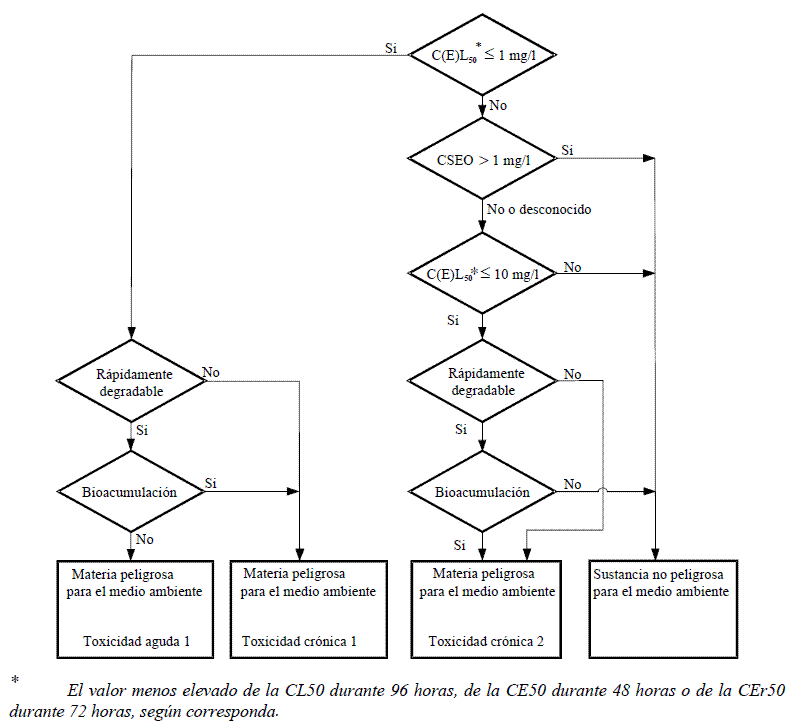
The following classification diagram indicates the process to be followed:
2.2.9.1.10.4 Categories and criteria for classification of mixtures
2.2.9.1.10.4.1 The classification system for mixtures comprises the categories used for classify the materials corresponding to Acute 1 toxicity and Chronic 1 and 2 toxicity.
In order to use all available data to classify environmental risks of each mixture, the following assumption is made which applies where applicable:
The "relevant components" of a mixture are those present in a concentration equal to or greater than 1% (by mass), unless the presumption exists (by for very toxic components) that a component is present in a a concentration below 1% may nevertheless be relevant to classifying the mixture in reason for its dangers to the aquatic environment.
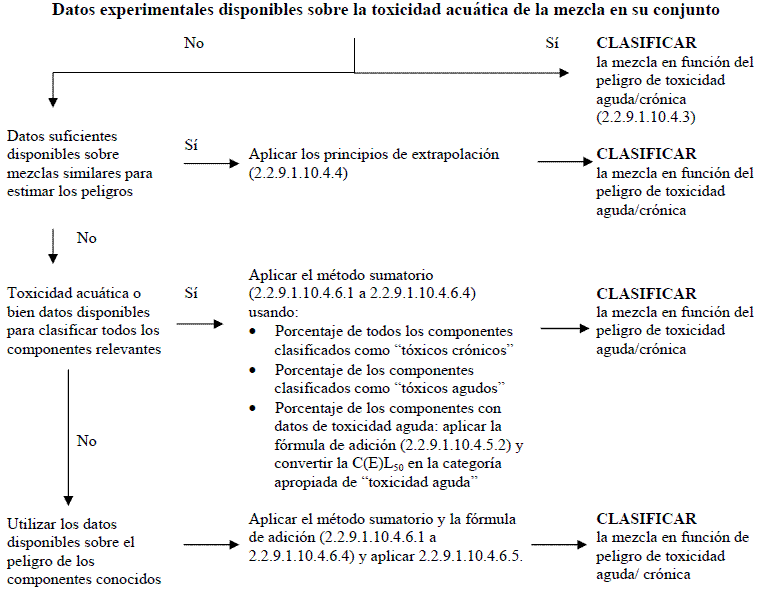
2.2.9.1.10.4.2 The classification of hazards to the aquatic environment is done by means of a sequential approach and depends on the type of information available about the mixture itself and its components. It comprises these elements:
(a) a classification based on the mixtures tested;
(b) a classification based on the principles of extrapolation;
(c) the method of “sum of classified components” and/or the application of a "addition formula."
The figure of 2.2.9.1.10.4.2 outlines the process to be followed.
Figure 2.2.9.1.10.4.2: A sequential approach to classifying mixtures for their environmental risks aquatic environment according to its acute and chronic toxicity
2.2.9.1.10.4.3 Classification of mixtures when mixing data are available as such
2.2.9.1.10.4.3.1 When mixing as such has been tested for toxicity water, shall be classified according to the criteria adopted for the materials, but only for acute toxicity. The classification shall be based on data on fish, crustaceans, algae/plants. Classification of mixtures in the chronic toxicity category from CL50 or CE50 data is not possible, as toxicity data are needed and on the fate/behaviour of the mixture in the environment and no data on degradability and bioaccumulation for mixtures as such. The criteria for Classification for chronic toxicity is not applicable in this case because they cannot be interpret the results of the degradability and bioaccumulation tests of mixtures. This data only makes sense when applied to individual subjects.
2.2.9.1.10.4.3.2 When acute toxicity test data (CL50 or EC50) are available for the mix as such, such data, as well as information on the classification of components according to their chronic toxicity, shall be used to complete the classification of mixtures tested as indicated below. They shall also be used, data on chronic (long-term) toxicity (CSEO), where available.
(a) C(E)L50 (CL50 or CE50) of the tested mixture. 1 mg/l and CSEO of the said mix. 1.0 mg/l, or unknown:
. classify the mixture into Acute 1 toxicity category;
. apply the summary method of the classified components (see 2.2.9.1.10.4.6.3 and 2.2.9.1.10.4.6.4) for classification in the toxicity category chronicle (Chronicle 1, 2) or to determine that such classification is not necessary;
(b) C(E)L50 of the tested mixture. 1 mg/l and CSEO of that mixture. 1.0 mg/l:
. classify the mixture into acute toxicity category 1;
. apply the sum method of the classified components (see 2.2.9.10.4.6.3 and 2.2.9.1.10.4.6.4) for classification in the category of Cronica toxicity 1. Yes. mixture is not classified in that category, the classification in the category of chronic toxicity is not necessary;
(c) C(E)L50 of the tested mixture. 1 mg/l, or greater than water solubility; and CSEO of that mixture 1.0 mg/l, or unknown:
. there is no need for classification in the acute toxicity category;
. apply the summary method of the classified components (see 2.2.9.1.10.4.6.3 and 2.2.9.1.10.4.6.4) for classification in the toxicity category or to determine that it is not necessary to classify in any of the categories of chronic toxicity;
(d) C(E)L50 of the mixture tested 1 mg/l, or higher than water solubility; and CSEO of that mixture. 1.0 mg/l:
. The mixture does not need to be classified in acute toxicity categories or chronicle.
2.2.9.1.10.4.4 Extrapolation principles
2.2.9.1.10.4.4.1 Where no tests have been conducted on the mixture itself to determine the hazard which presents for the aquatic environment but sufficient data is available on its individual components and similar mixtures tested to characterize their hazards, such data should be used in accordance with the extrapolation described below. In this way the use of the major is ensured number of data available during the classification process in order to characterize the the risks of mixing without further testing on animals.
2.2.9.1.10.4.4.2 Dilution
2.2.9.1.10.4.4.2.1 If the mixture results from the dilution of another classified mixture or a matter with a diluent classified in a toxicity category equal to or less than that of the component less toxic and is not expected to influence the toxicity of the rest of the mixture shall be considered, for classification purposes, as equivalent to the original mixture or matter.
2.2.9.1.10.4.4.2.2 If a mixture results from the dilution of another classified mixture or a matter in water or other non-toxic material, the toxicity of the mixture shall be calculated according to that of the mixture or original matter.
2.2.9.1.10.4.4.3 Batch variation
The toxicity of a batch of a complex mixture with respect to the aquatic environment is be considered equivalent to that of another lot of the same commercial product and obtained by the the same manufacturer or under his control, unless there is reason to believe that the composition of the mixture has changed and that such changes may cause changes in the Batch toxicity values for the aquatic environment, where necessary a new classification.
2.2.9.1.10.4.4.4 Concentration of mixtures classified in the most toxic categories (chronic toxicity 1 and acute toxicity (1).
If a mixture is classified under Chronic 1 and/or Acute 1 toxicity categories and increased the concentration of the components of the mixture which are classified in those same categories, the concentrated mixture shall be classified in the same category as the original mixture no further testing is necessary.
2.2.9.1.10.4.4.5 Interpolation within the same toxicity category If mixtures A and B appear in the same classification category and a C mixture is made where toxicologically active components have intermediate concentrations with for mixtures A and B, then mixture C shall be in the same category as A y B. Note that all three mixtures are made up of the same components.
2.2.9.1.10.4.4.6 Materially similar mixtures
Where the following is available:
(a) Two mixtures:
i) A + B;
(ii) C + B;
(b) The concentration of component B is the same in both mixtures;
(c) The concentration of component A in mixture (i) is equal to that of component C in mixture (ii);
(d) Data are available on the classification of A and C and this classification is the the same category of danger, i.e. both matters are listed in the same category of danger and are not expects them to affect the aquatic toxicity of B; then it will not be necessary to test mixture (ii), if mixture (i) is already on the basis of experimental data and both mixtures are listed in the same category.
2.2.9.1.10.4.5 Classification of mixtures when data are available for all components or only about some of them
2.2.9.1.10.4.5.1 The classification of a mixture shall be based on the sum of its classification components. The percentage of components classified as "acute toxic" or "chronic toxics" will be introduced directly into the summation method. The details of This method is described in 2.2.9.1.10.4.6.1 to 2.2.9.1.10.4.6.4.
2.2.9.1.10.4.5.2 Mixtures are often made with a combination of both components that are classified (in acute toxicity categories 1 and/or chronic toxicity categories 1, 2) as those for which adequate data are available from the tests.
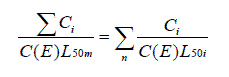
When adequate toxicity data are available for more than one component of the mixture, the combined toxicity of these components shall be calculated using the formula the following addition, and the toxicity thus calculated shall be used to assign that portion of the mixture a hazard of acute toxicity to be used immediately for apply the summary method.
 where:
Ci = concentration of component i (mass percentage);
L(E)C50i = CL50 or CE50 (in mg/l) of component i;
n = number of components, varying i from 1 to n;
C(E)L50m = C(E)L50 of the mixing part with test data.
2.2.9.1.10.4.5.3 If the addition formula is applied to part of the mixture, it is preferable to calculate the toxicity of this part of the mixture, introducing for each component, toxicity to the same species (fish, dafnia or algae) and then selecting the highest toxicity (lowest value) obtained with the most sensitive species of all three. However, where data are not available toxicity for each component in the same species, the toxicity value of each component will be selected in the same way that the values of toxicity to classify materials, i.e. the highest toxicity (of Most sensitive body tested). The calculated acute toxicity will be used then to classify that part of the mixture into acute toxicity category 1 with the same criteria as those described for the subjects.
2.2.9.1.10.4.5.4 When a mixture has been classified in different ways, the method should be taken which throw the most restrictive result.
2.2.9.1.10.4.6 Summary method
2.2.9.1.10.4.6.1 Classification procedure
Generally, a more severe classification of mixtures is imposed on a classification less severe, for example, a classification in the category Cronica 1 prevails over a classification in the category Cronica 2. Consequently, the procedure for classification will be considered already completed when the results yield toxicity Chronicle 1. A more severe classification than this last is not possible and therefore will not be the classification procedure must be continued.
2.2.9.1.10.4.6.2 Classification of Acute Category 1
2.2.9.1.10.4.6.2.1 All components classified in Acute Category 1 shall be considered. If the sum of these components is 25% or more, the whole mixture shall be classified in the Acute Category 1. If the result of the calculation is a classification of the mixture in that category, the classification process will be over. 2.2.9.1.10.4.6.2.2 The classification of mixtures in function of their acute toxicity, by the sum of the classified components are summarised in Table 2.2.9.1.10.4.6.2.2 below.
Table 2.2.9.1.10.4.6.2.2 : Classification of mixtures in function of their acute toxicity, by the sum of the classified components
Sum of components classified in: The mixture is classified as:
Acute toxicity 1~Ma. 25% Acute toxicity 1 a Factor M is explained in 2.2.9.1.10.4.6.4
2.2.9.1.10.4.6.3 Classification in the categories Cronica 1 or 2
2.2.9.1.10.4.6.3.1 First of all components classified in the category Chronicle 1. If the sum of those components is 25% or more, the mixture shall be it will qualify in the category Cronica 1. If the result of the calculation is a classification of the mix in that category, the sorting process will be over.
2.2.9.1.10.4.6.3.2 In cases where the mixture is not classified in category 1 Cronica, it shall be considered the classification of the mixture in the category Cronica 2. A mixture shall be classified in the category Chronicle 2 if the sum of all components classified in category Chronicle 1 multiplied by 10, plus the sum of all components classified in the category Cronica 2 is 25% or more. If the result of the calculation is a Classification of the mixture in that category, the classification process will be finished.
2.2.9.1.10.4.6.3.3 classifying mixtures in function of their chronic toxicity by the sum of the classified components are summarized in Table 2.2.9.1.10.4.6.3.3 below.
Table 2.2.9.1.10.4.6.3.3: Classification of mixtures in function of their chronic toxicity, by the sum of the classified components
Sum of components classified as: The mixture is classified as:
Chronicle 1 ~ Ma Cronica 1
(M~10 ~Cronica 1) + Chronicle 2 Chronicle 2
a Factor M is explained in 2.2.9.1.10.4.6.4.
2.2.9.1.10.4.6.4 Mixtures with highly toxic components
Components classified in Acute Category 1 with toxic effects a concentrations well below 1 mg/l may influence the toxicity of the mixture and this reason is assigned a greater weight in the summary method of the components classified. When a mixture contains components classified in the category Acute 1 or Cronica 1, the sequential approach described in 2.2.9.1.10.4.6.2 and 2.2.9.1.10.4.6.3 be applied using a weighted sum obtained by multiplying concentrations of acute category 1 components by a multiplication factor, instead of adding simply the percentages. This means that concentration of "Aguda 1" in the column of the left of Table 2.2.9.1.10.4.6.2.2 and the concentration of "Cronica 1" in the left column of Table 2.2.9.1.10.4.6.3.3 are multiplied by the factor appropriate. The factors for multiplying these components are defined using the toxicity value as summarized in Table 2.2.9.1.10.4.6.4 below.
Therefore, in order to classify a mixture with components of acute toxicity 1 and/or Cronica 1, who classifies will need to be informed of the value of the M factor to apply the summatory method. The addition formula may also be used as an alternative (see
2.2.9.1.10.4.5.2) when toxicity data are available for all components highly toxic of the mixture and there is convincing evidence that all other components, including those for which acute toxicity data are not available, are little or no toxic and do not contribute significantly to the environmental hazard of mix.
Table 2.2.9.1.10.4.6.4: Multiplication factors for highly toxic components of mixtures
Value of C(E)L50 Multiplication Factor (M)
0,1 < C(E)L50 . 1 1
0,01 < C(E)L50 . 0,1 10
0,001 < C(E)L50 . 0,01 100
0,0001 < C(E)L50 . 0,001 1000
0,00001 < C(E)L50 . 0,0001 10000
(continue at factor 10 intervals)
2.2.9.1.10.4.6.5 Classification of mixtures with components not available usable information
Where there is no usable information on the acute and/or chronic aquatic hazard of one or more relevant components, it should be concluded that the mixture cannot be assigned to No definitive danger category. In that situation, the mixture shall be classified based only on known components with the additional mention that: g ~ % of the mixture consists of one or more components of unknown danger to the half aquatic h.
2.2.9.1.10.5 Materials or mixtures dangerous to the aquatic environment not elsewhere classified in the ADR.
2.2.9.1.10.5.1 Substances or mixtures dangerous to the aquatic environment not elsewhere classified the ADR shall be designated as follows:
UN No 3077 solid matter dangerous to the environment, n.e.c.; or
UN 3082 liquid matter dangerous to the environment, n.e.c.
They will be assigned to packing group III.
2.2.9.1.10.5.2 Notwithstanding the provisions of 2.2.9.1.10,
(a) matters which cannot be assigned to sections other than UN Nos 3077 and 3082 of class 9 or other sections of classes 1 to 8, and not identified Council Directive 67/548/EEC of 27 June 1967 on the approximation of legislation, regulations and administrative provisions relating to the classification, packaging and labelling of dangerous materials12, and their successive amendments, such as matters to which letter N has been placed “environmentally hazardous” (R50; R50/53; R51/53); y
(b) solutions and mixtures (such as preparations and residues) of materials to which they are intended it has placed the letter N “environmentally dangerous” (R50; R50/53; R51/53) in Directive 67/548/EEC and its successive amendments should be allocated only to UN 3077 or 3082 if, in accordance with Directive 1999/45/EEC of the European Parliament and of the Council of 31 May 1999 on the approximation of legislation, regulations and administrative provisions of the Member States relating to classification, packaging and labelling of dangerous preparations13, and its successive amendments, are affected by the letter N “environmentally dangerous” (R50; R50/53; R51/53) and no may be assigned to one of Classes 1 to 8; UN 3077 or 3082 Class 9 as appropriate.
Article 7 Directive 1999/45/EEC
ANNEX III .- methods for assessing the risks of UN prepared for the environment in accordance with Article 7
PART A .- Method of environmental risk assessment
PART B .- Concentration limits to be used for environmental hazard assessment
PART C .- Test methods for the assessment of hazards to the aquatic environment
Links .- Safety sheets, lists and databases of chemicals
Examples of goods with hazard phrases R50 / R50-53 / R51-53 - letter N
R50 Very toxic to aquatic organisms.
R50/53 Very toxic to aquatic organisms, it can cause long-term adverse effects on the aquatic environment.
R51/53 Toxic to aquatic organisms, it can cause long-term adverse effects on the aquatic environment.
Article 7 Directive 1999/45/EEC
Environmental hazard assessment
1. The hazards of an environmental preparation shall be assessed according to one or more of the following procedures:
(a) a conventional method of calculation described in Annex III to this Directive;
(b) the determination of the dangerous properties of the preparation for the environment necessary for an appropriate classification in accordance with the criteria defined in Annex VI to Directive 67/548/EEC. These properties shall be determined according to the methods laid down in the Part C of Annex V to Directive 67/548/EEC, unless other internationally recognised methods for plant protection products are acceptable in accordance with the provisions of Annexes II and III to Directive 91/414/EEC. Without prejudice to the test requirements laid down in Directive 91/414/EEC, the conditions for the application of those test methods shall be described in the Part C to Annex III to this Directive.
2. Where ecotoxicological property is established in accordance with one of the methods set out in paragraph 1(b) for obtaining new data, tests shall be carried out in accordance with the principles of good laboratory practice referred to in Directive 87/18/EEC and the provisions of Directive 86/609/EEC.
Where environmental hazards have been established in accordance with the two above procedures, the result obtained by the methods referred to in paragraph 1(b) shall be used to classify the preparation.
3. For preparations of known composition other than those provided for in Directive 91/414/EEC, classified according to the method referred to in paragraph 1(b), a new assessment of the hazard to the environment shall be carried out by the method referred to in paragraph 1(a) or the method referred to in paragraph 1(b) where:
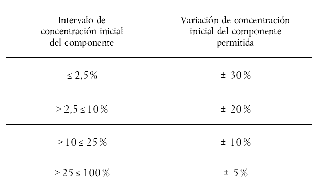
- the manufacturer changes its composition by replacing or adding one or more components, whether they are hazardous components within the definitions set out in Article 2 or not.
This new assessment shall apply unless there is valid scientific justification for considering that a risk reassessment will not lead to a change in the classification.
Methods for assessing the risks of UN prepared for the environment in accordance with Article 7
Introduction
The systematic assessment of all effects dangerous to the environment is expressed by concentration limits expressed as a percentage weight/weight, except for gaseous preparations, in which they are expressed as a percentage volume/volume, in relation to the classification of the substance.
The Part A indicates the assessment method set out in Article 7(1)(a), as well as the risk phrases (R-phrases) to be used to classify the preparation.
The Part B indicates the concentration limits to be used in the case of application of the conventional method, as well as the symbols and R phrases to be used for classification.
In accordance with Article 7(1)(a) the environmental risks of a preparation shall be assessed by means of the conventional method described in Parts A and B of this Annex, using the individual concentration limits:
(a) Where the hazardous substances listed in Annex I to Directive 67/548/EEC have been assigned the concentration limits necessary for the application of the assessment method described in the Part A of this Annex, those concentration limits shall be used.
(b) where dangerous substances are not listed in Annex I to Directive 67/548/EEC or appear therein without the concentration limits necessary for the application of the assessment method described in Part A of this Annex, the concentration limits conforming to the specification contained in the Part B of this Annex.
The Part C indicates the test methods for assessing hazards to the aquatic environment.
Method of environmental risk assessment
(a) Aquatic environment
I. Conventional method of assessment of hazards to the aquatic environment
The conventional method of hazard assessment for the aquatic environment takes into account all risks that a substance may present for this environment according to the following specifications:
The following preparations shall be classified as hazardous to the environment:
1. and the symbol "N", the hazard indication "dangerous to the environment" and the risk phrases R50 and R53 (R50-53) shall apply to them:
1.1. preparations containing one or more substances classified as hazardous to the environment and to which R50-53 phrases and an individual concentration equal to or greater apply:
(a) either as set out in Annex I to Directive 67/548/EEC for the substance or substances concerned,
(b) either as set out in Part B of this Annex (Table 1) where the substance or substances are not listed in Annex I to Directive 67/548/EEC or where they appear without concentration limits;
1.2. preparations containing several substances classified as hazardous to the environment and to which phrases R50-53 apply at an individual concentration below the limits set out in point I.1.1(a) or (b), if:
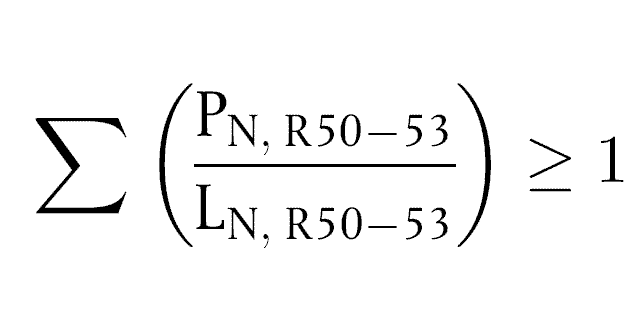
where:
PN, R50-53 = the percentage by weight of each substance dangerous to the environment to which the phrases R50-53 contained in the preparation apply,
LN, R50-53 = the limit R50-53 set for each substance to which the phrases R50-53 apply and expressed as a percentage by weight;
2. and the symbol "N", the hazard indication "dangerous to the environment" and the risk phrases R51 and R53 (R51-53) shall apply to them, unless the preparation has already been classified in accordance with point I.1;
2.1. preparations containing one or more substances classified as dangerous to the environment and to which phrases R50-53 or R51-53 apply at an individual concentration equal to or greater than:
(a) either as set out in Annex I to Directive 67/548/EEC for the substance or substances concerned,
(b) either as set out in Part B of this Annex (Table 1) where the substance or substances are not listed in Annex I to Directive 67/548/EEC or where they appear without concentration limits;
2.2. preparations containing several substances classified as hazardous to the environment and to which phrases R50-53 or R51-53 apply at an individual concentration below the limits set out in point I.1.1.a) or (b) apply if:
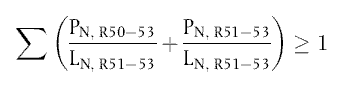
where:
PN, R50-53 = the percentage by weight of each substance dangerous to the environment to which the phrases R50-53 contained in the preparation apply,
PN, R51-53= the percentage by weight of each substance dangerous to the environment to which the phrases R51-53 contained in the preparation apply,
LN, R51-53 = the respective limit R51-53 set for each substance hazardous to the environment and to which phrases R50-53, expressed as a percentage by weight, apply;
3. and the risk phrases R52 and R53 (R52-53) shall apply to them, unless the preparation has already been classified in accordance with points I.1 or I.2;
3.1. preparations containing one or more substances classified as dangerous to the environment and to which phrases R50-53, R51-53 or R52-53 apply at an individual concentration equal to or greater than:
(a) either as set out in Annex I to Directive 67/548/EEC for the substance or substances concerned,
(b) either as set out in Part B of this Annex (Table 1) where the substance or substances are not listed in Annex I to Directive 67/548/EEC or where they appear without concentration limits;
3.2. preparations containing several substances classified as dangerous to the environment and to which phrases R50-53, R51-53 or R52-53 apply at an individual concentration below the limits set out in point I.3.1(a) or (b) apply if:

where:
PN, R50-53 = the percentage by weight of each substance dangerous to the environment to which the phrases R50-53 contained in the preparation apply,
PN, R51-53= the percentage by weight of each substance dangerous to the environment to which the phrases R51-53 contained in the preparation apply,
PR52-53 = the percentage by weight of each substance hazardous to the environment to which the phrases R52-53 contained in the preparation apply,
LR52-53 = the respective limit R52-53 set for each substance dangerous to the environment and to which the phrases R50-53, R51-53 or R52-53 expressed as a percentage by weight apply;
4. and the symbol "N", the hazard indication "dangerous to the environment" and the risk phrase R50 shall apply to them, unless the preparation has already been classified in accordance with point I.1;
4.1. preparations containing one or more substances classified as dangerous to the environment and to which the phrase R50 applies at an individual concentration equal to or greater than:
(a) either as set out in Annex I to Directive 67/548/EEC for the substance or substances concerned,
(b) either as set out in Part B of this Annex (Table 2) where the substance or substances are not listed in Annex I to Directive 67/548/EEC or where they appear without concentration limits;
4.2. preparations containing several substances classified as hazardous to the environment and to which the phrase R50 applies at an individual concentration below the limits set out in point I.4.1(a) or (b), if:
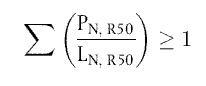
where:
PN, R50 = the percentage by weight of each substance hazardous to the environment to which the phrase R50 contained in the preparation applies;
LN, R50 = the respective R50 limit set for each substance hazardous to the environment and to which the phrase R50 is applied expressed as a percentage by weight;
4.3. preparations containing several substances classified as dangerous to the environment and to which R50 applies, and which do not meet the criteria referred to in point I.4.1 or I.4.2 and contain one or more substances classified as hazardous to the environment and to which the R50-53 phrases apply
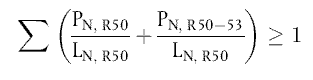
where:
PN, R50 = the percentage by weight of each substance hazardous to the environment to which the phrase R50 contained in the preparation applies;
PN, R50-53 = the percentage by weight of each substance dangerous to the environment to which the phrases R50-53 contained in the preparation apply,
LN, R50 = the respective R50 limit for each substance dangerous to the environment and to which the phrases R50 or R50-53 are applied expressed as a percentage by weight;
5. and the risk phrase R52 shall apply to them unless the preparation has already been classified in accordance with points I.1, I.2, I.3 or I.4:
5.1. preparations containing one or more substances classified as hazardous to the environment and to which the phrase R52 applies at an individual concentration equal to or greater than:
(a) either as set out in Annex I to Directive 67/548/EEC for the substance or substances concerned,
(b) either as set out in Part B to this Annex (Table 3) where the substance or substances are not listed in Annex I to Directive 67/548/EEC or where they appear without concentration limits;
5.2. preparations containing several substances classified as hazardous to the environment and to which the phrase R52 applies at an individual concentration below the limits set out in point I.5.1.a) or (b), if:
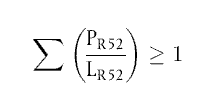
where:
PR52= the percentage by weight of each substance hazardous to the environment to which the phrase R52 contained in the preparation applies,
LR52 = the respective R52 limit set for each substance hazardous to the environment and to which the phrase R52 is applied expressed as a percentage by weight;
6. and the risk phrase R53 shall apply to them, unless the preparation has already been classified in accordance with points I.1, I.2 or I.3;
6.1. preparations containing one or more substances classified as dangerous to the environment and to which phrase R53 applies at an individual concentration equal to or greater:
(a) either as set out in Annex I to Directive 67/548/EEC for the substance or substances concerned,
(b) either as set out in Part B to this Annex (Table 4) where the substance or substances are not listed in Annex I to Directive 67/548/EEC or where they appear without concentration limits;
6.2. preparations containing several substances classified as hazardous to the environment and to which the phrase R53 applies at an individual concentration below the limits set out in point I.6.1.a) or (b), if:
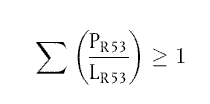
where:
PR53 = the percentage by weight of each substance hazardous to the environment to which the phrase R53 contained in the preparation applies,
LR53 = the respective R53 limit set for each substance hazardous to the environment and to which the phrase R53 is applied expressed as a percentage by weight;
6.3. preparations containing several substances classified as dangerous to the environment and to which R53 applies, which do not meet the criteria referred to in point 1.6.2 and which contain one or more substances classified as hazardous to the environment and to which phrases R50-53, R51-53 or R52-53 apply where:

where:
PR53 = the percentage by weight of each substance hazardous to the environment to which the phrase R53 contained in the preparation applies,
PN, R50-53 = the percentage by weight of each substance dangerous to the environment to which the phrases R50-53 contained in the preparation apply,
PN, R51-53= the percentage by weight of each substance dangerous to the environment to which the phrases R51-53 contained in the preparation apply,
PR52-53 = the percentage by weight of each substance hazardous to the environment to which the phrases R52-53 contained in the preparation apply,
LR53 = the respective R53 limit set for each substance hazardous to the environment and to which the phrases R53, R50-53, R51-53 or R52-53 as a percentage by weight apply.
Concentration limits to be used for environmental hazard assessment
I. For the aquatic environment
The concentration limits set out in the following tables and expressed as a percentage of weight/weight determine the classification of the preparation according to the individual concentration of the present substance or substances, the classification of which is also indicated.
Test methods for the assessment of hazards to the aquatic environment
Classification of a preparation is usually done according to the conventional method. However, in some cases the preparation may be tested to determine its acute aquatic toxicity.
The results of these preparation tests can only change the classification for acute aquatic toxicity that would be obtained using the conventional method.
If the person responsible for placing the product on the market chooses these tests, they shall be carried out in accordance with the quality criteria of the methods set out in Part C Annex V to Directive 67/548/EEC.
In addition, the tests shall be carried out on each of the three species provided for in accordance with the criteria set out in Annex VI to Directive 67/548/EEC (algae, dafnia and fish), unless the highest hazard classification relating to acute aquatic toxicity has already been attributed to the preparation after the test in one of the species or the result of a test before the entry into force of this Directive is already available.
Safety cards MTAS - Spanish
Limitations on the use and consumption of chemical agents MTAS - Spanish
Annex I to Royal Decree 363/1995 of 10 March 1995 regulating the notification of new substances and classification, packaging and labelling of dangerous substances and their subsequent amendments
Annex I to Directive 67/548/EEC (Regulation 1272/2008 - USG) EU: this is the official and updated database where you can find the letter N with danger phrases R50 / R50-53 / R51-53 for classification as class 9 for ADR 2011
Find: materials with N
R50 Very toxic to aquatic organisms.
007-001-01-2 AMONIACO ... %
015-025-00-2 TEPP (ISO)
015-028-00-9 DEMETON-O (ISO)
015-046-00-7 TIOFOSFATO DE O,O-DIMETILO Y DE S-(2-ETILSULFINIL-ETILO)
015-118-00-8 DEMETON
053-001-00-3 YODO
602-053-00-0 ISOBENZAN (ISO)
604-007-00-5 2-NAFTOL
604-020-00-6 BIFENIL-2-OL
607-066-00-5 ACIDO DICLOROACETICO
607-067-00-0 CLORURO DE DICLOROACETILO
607-070-00-7 CLOROACETATO DE ETILO
607-081-00-7 ACIDO FLUOROACETICO
607-082-00-2 FLUOROACETATOS SOLUBLES
607-169-00-5 FLUOROACETATO DE SODIO
616-009-00-3 PROPANIL (ISO)
R50/53 Very toxic to aquatic organisms, it can cause long-term adverse effects on the aquatic environment.
050-017-00-2 OXIDO DE FENBUTATINA (ISO)
006-006-00-X ACIDO CIANHIDRICO
006-007-00-5 SALES DEL ACIDO CIANHIDRICO, EXCEPTO LOS CIANUROS COMPLEJOS, TALES COMO LOS FERROCIANUROS Y FERRICIANUROS Y OXICIANURO DE MERCURIO
006-015-00-9 DIURON (ISO)
006-017-00-X ALDICARB (ISO)
006-019-00-0 DIALATO (ISO)
006-020-00-6 BARBAN (ISO)
006-021-00-1 LINURON (ISO)
006-031-00-6 FORMETANATO
006-038-00-4 SULFALATO (ISO)
006-039-00-X TRIALATO (ISO)
006-042-00-6 MONURON (ISO)
006-043-00-1 MONURON-TCA
006-044-00-7 ISOPROTURON
006-046-00-8 BENDIOCARB (ISO)
006-052-00-0 FORMETANATO,CLORHIDRATO
006-054-00-1 MEXACARBATO (ISO)
006-079-00-8 "DISULFIRAMO OXIGENO"
Zinc 006-081-009 bis(dibutyldithiocarbamate)
006-084-00-5 [(DIBUTILAMINO)TIO]METILCARBAMATO DE 2,3-DIHIDRO-2,2-DIMETIL-7-BENZOFURILO
007-021-00-4 HIDRAZOBENCENO
007-024-00-0 CLORATO DE 2-(DECILTIO)ETILAMONIO
011-004-00-7 AZIDURO DE SODIO
015-038-00-3 CUMAFOS (ISO)
015-056-00-1 AZINFOS-ETIL (ISO)
015-064-00-5 BROMOFOS-ETIL (ISO)
015-067-00-1 FOSALON
015-069-00-2 METIDATION (ISO)
015-071-00-3 CLORFENVINFOS (ISO)
015-073-00-4 DICROTOFOS (ISO)
015-088-00-6 DIALIFOS (ISO)
015-093-00-3 LEPTOFOS (ISO)
015-098-00-0 TRICLORONATO (ISO)
015-099-00-6 PIRIMIFOS-ETILO (ISO)
015-140-00-8 TRIAZOFOS (ISO)
015-141-00-3 DITIOFOSFATO DE ETILENDIAMONIO Y O,O-BIS(OCTILO), MEZCLA DE ISOMEROS
015-156-00-5 [1] 3-[(DIMETOXIFOSFINOTIOIL)OXI]METACRILATO DE METILO
015-156-00-5 [2] "METACRIFOS (ISO)"
016-021-00-3 METANOTIOL
016-022-00-9 ETANOTIOL
016-083-00-1 ACIBENZOLAR-S-METIL
020-002-00-5 CIANURO DE CALCIO
024-008-00-9 CROMATO DE CALCIO
024-009-00-4 CROMATO DE ESTRONCIO
024-017-00-8 COMPUESTOS DE CROMO (VI),EXCEPTO EL CROMATO DE BARIO Y DE LOS ESPECIALMENTE CITADOS EN ESTE ANEXO
025-002-00-9 PERMANGANATO DE POTASIO
027-002-00-4 ÓXIDO DE COBALTO
028-006-00-9 SULFURO DE NÍQUEL
029-003-00-5 ACIDOS NAFTENICOS, SALES DE COBRE
029-004-00-0 SULFATO DE COBRE
029-008-00-2 METANSULFONATO DE COBRE(II)
030-007-00-4 BIS(3,5-DI-terc-BUTILSALICILATO-O1,O2)CINC
033-004-00-6 PENTAOXIDO DE DIARSENICO
033-005-00-1 ACIDO ARSENICO Y SUS SALES
034-002-00-8 COMPUESTOS DE SELENIO, EXCEPTO EL SULFOSELENIURO DE CADMIO
042-003-00-X HEXA-MU-OXOTETRA-MU3-OXODI-MU5-OXOTETRADECAOXOOCTAMOLIBDATO(4-) DE TETRAKIS(TRIMETILHEXADECILAMONIO)
080-001-00-0 MERCURIO
080-002-00-6 COMPUESTOS INORGANICOS DE MERCURIO, EXCEPTO EL SULFURO MERCURICO (CINABRIO) Y LOS ESPECIFICAMENTE EXPRESADOS EN ESTE ANEXO
080-003-00-1 DICLORURO DE DIMERCURIO
080-004-00-7 COMPUESTOS ORGANICOS DE MERCURIO, EXCEPTO LOS ESPECIFICAMENTE EXPRESADOS EN ESTE ANEXO
080-007-00-3 [1] DIMETILMERCURIO
080-007-00-3 [2] DIETILMERCURIO
080-008-00-9 [1] NITRATO DE FENILMERCURIO
080-008-00-9 [2] HIDROXIDO DE FENILMERCURIO
080-008-00-9 [3] NITRATO DE FENILMERCURIO BASICO
080-009-00-4 CLORURO DE 2-METOXIETILMERCURIO
080-011-00-5 ACETATO DE FENILMERCURIO
601-048-00-0 CRISENO
601-053-00-8 [1] NONILFENOL
601-053-00-8 [2] 4-NONILFENOL, RAMIFICADO
602-034-00-7 1,2-DICLOROBENCENO
602-041-00-5 PENTACLORONAFTALENO
602-043-00-6 GAMMA-1,2,3,4,5,6-HEXACLOROCICLOHEXANO
602-045-00-7 DDT (NOMBRE COMÚN NO ADOPTADO POR ISO)
602-047-00-8 CLORDANO (ISO)
602-048-00-3 ALDRIN (ISO)
602-051-00-X ENDRIN (ISO)
602-052-00-5 ENDOSULFAN (ISO)
602-065-00-6 HEXACLOROBENCENO
602-071-00-9 BROMOBENCILBROMOTOLUENO, MEZCLA DE ISOMEROS
602-074-00-5 PENTACLOROBENCENO
602-083-00-4 DIFENIL ÉTER, DERIVADO PENTABROMADO
602-087-00-6 1,2,4-TRICLOROBENCENO
602-089-00-7 4-BROMO-2-CLOROFLUOROBENCENO
603-156-00-3 2-(2,4-DICLOROFENIL)-2-(2-PROPENIL)OXIRANO
604-013-00-8 2,3,4,6-TETRACLOROFENOL
604-017-00-X 2,4,5-TRICLOROFENOL
604-019-00-0 DICLOROFENO
604-024-00-8 4,4'-ISOBUTILETILIDENDIFENOL
604-041-00-0 [1] ACIDO 5-[2-CLORO-4-(TRIFLUOROMETIL)FENOXI]-2-NITROBENZOICO
604-041-00-0 [2] 5-[2-CLORO-4-(TRIFUOROMETIL)FENOXI]-2-NITROBENZOATO DE SODIO
604-053-00-6 2-METIL-4-(1,1-DIMETILETIL)-6-(1-METIL-PENTADECIL)-FENOL
604-062-00-5 2,4-DIMETIL-6-(1-METIL-PENTADECIL)-FENOL
606-014-00-9 CLOROFACINONA (ISO)
606-018-00-0 DICLONA (ISO)
606-019-00-6 CLORDECON (ISO)
606-044-00-2 2,4,6-TRIMETILBENZOFENONA
607-041-00-9 2,4,5-T
607-042-00-4 SALES Y ESTERES DEL 2,4,5-T
607-047-00-1 FENOPROP
607-076-00-X DODINA
607-151-00-7 PROPARGITA (ISO)
607-156-00-4 CLOROFENSON (ISO)
607-157-00-X 3-(3-BIFENIL-4-IL-1,2,3,4-TETRAHIDRO-1-NAFTIL)-4-HIDROXICUMARINA
607-165-00-3 2-(4-(2,4-DICLOROFENOXI)FENOXI)PROPIONATO DE METILO
607-168-00-X 6,7-METILENDIOXI-1,2,3,4-TETRAHIDRO-3-METILNAFTALENO-1,2-DICARBOXILATO DE DIPROPILO
607-172-00-1 4-HIDROXI-3-(3-(4'-BROMO-4-BIFENILIL)-1,2,3,4-TETRAHIDRO-1-NAFTIL)CUMARINA
607-191-00-5 3,4-EPOXIBUTIRATO DE ISOBUTILO
607-209-00-1 MEZCLA DE: O,O-DI(1-METILETIL)TRITIO-BIS-TIOFORMATO;O,O-DI(1-METILETIL)TETRATIO-BIS-TIOFORMATO;O,O-DI(1-METILETIL)PENTATIO-BIS-TIOFORMATO
607-232-00-7 PIRIDATO (ISO)
607-238-00-X TAU-FLUVALINATE
607-242-00-1 ANIHIDRIDO TETRACLOROFTALICO
607-253-00-1 3-(2,2-DICLOROVINIL)-2,2-DIMETILCICLOPROPANOCARBOXILATO DE alfa-CIANO-3-FENOXI-4-FLUOROBENCILO
607-290-00-3 MEZCLA (PROPORCIÓN DESCONOCIDA) DE: AMONIO 1-C14-C18-ALQUILOXICARBONIL-2-(3-ALILOXI-2-HIDROXIPROPOXICARBONIL)ETAN-1-SULFONATO;AMONIO 2-C14-C18-ALQUILOXICARBONIL-1-(3-ALILOXI-2-HIDROXIPROPOXICARBONIL)ETAN-1-SULFONATO
607-299-00-2 3-(ACETILTIO)-2-METIL-PROPANATO DE METILO
607-308-00-X ÉSTERES DE 2,4-D
607-328-00-9 4-BROMOMETIL-3-METOXIBENZOATO DE METILO
607-333-00-6 MEZCLA DE: N-(2,2,6,6-TETRAMETILPIPERIDIN-4-IL)-beta-ALANINATO DE DODECILO; N-(2,2,6,6-TETRAMETILPIPERIDIN-4-IL)-beta-ALANINATO DE TETRADECILO
607-375-00-5 MEZCLA DE: cis-4-HIDROXI-3-(1,2,3,4-TETRAHIDRO-3-(4-(4-TRIFLUOROMETILBENCILOXI)FENIL)-1-NAFTIL)CUMARINA; trans-4-HIDROXI-3-(1,2,3,4-TETRAHIDRO-3-(4-(4-TRIFLUOROMETILBENCILOXI)FENIL)-1-NAFTIL)CUMARINA
608-011-00-8 OXALONITRILO
608-017-00-0 OCTANOATO DE BROMOXINILO (ISO)
608-018-00-6 OCTANOATO DE IOXINILO (ISO)
609-004-00-2 [1] DINITROBENCENO
609-004-00-2 [2] 1,4-DINITROBENCENO
609-004-00-2 [3] 1,3-DINITROBENCENO
609-004-00-2 [4] 1,2-DINITROBENCENO
609-016-00-8 [1] DINITROFENOL
609-016-00-8 [2] 2,4 (o 2,6)-DINITROFENOL
609-021-00-5 [1] SAL DE SODIO DEL DNOC
609-021-00-5 [2] SAL DE POTASIO DEL DNOC
609-022-00-0 SAL DE AMONIO DEL DNOC
609-024-00-1 BINAPACRIL (ISO)
609-044-00-0 TECNACENO (ISO)
609-046-00-1 TRIFLURALINA (ISO) (CONTENIDO < 0.5 PPM NPDA)
610-003-00-4 CLORODINITROBENCENO
610-004-00-X 2-CLORO-1,3,5-TRINITROBENCENO
611-064-00-X 4-(3,4-DICLOROFENILAZO)-2,6-DI-sec-BUTIL-FENOL
611-089-00-6 METILSULFATO DE 2-((4-(ETIL-(2-HIDROXIETIL)AMINO)-2-METILFENIL)AZO)-6-METOXI-3-METIL-BENZOTIAZOLIO
612-010-00-8 CLOROANILINA (MONO-,DI-,TRI-)
612-015-00-5 N-METILANILINA
612-026-00-5 DIFENILAMINA
612-029-00-1 [1] m-FENILENODIAMINA,DICLORHIDRATO
612-042-00-2 BENCIDINA
612-064-00-2 3,6,9,12-TETRAAZATETRADECANO-1,14-DIAMINA
612-066-00-3 DICICLOHEXILAMINA
612-070-00-5 [1] SALES DE BENCIDINA [1]
612-070-00-5 [2] SALES DE BENCIDINA [2]
612-070-00-5 [3] SALES DE BENCIDINA [3]
612-070-00-5 [4] SALES DE BENCIDINA [4]
612-078-00-9 2,2'-DICLORO-4,4'-METILENDIANILINA
612-079-00-4 SALES DE 2,2'-DICLORO-4,4'-METILENDIANILINA
612-087-00-8 GUAZATINA
612-095-00-1 BENZOATO DE BENCIL-2-HIDROXIDODECILDIMETILAMONIO
612-113-00-8 6-METIL-2,4-BIS(METILTIO)FENILENO-1,3-DIAMINA
612-128-00-X 4-AMINOFENOL
612-130-00-0 [1] 2,6-DIAMINO-3,5-DIETILTOLUENO
612-130-00-0 [2] 2,4-DIAMINO-3,5-DIETILTOLUENO
612-130-00-0 [3] DIETILMETILBENCENODIAMINA
612-134-00-2 SESQUISULFATO DE N-(2-(4-AMINO-N-ETIL-M-TOLUIDINO)ETIL) METANOSULFONAMIDA
612-136-00-3 N'-FENIL-N-ISOPROPIL-p-FENILENDIAMINA
612-141-00-0 4,4'-METILENBIS(2-ETILANILINA)
612-144-00-7 FLUMETRALINA (ISO)
612-159-00-9 PRODUCTOS DE REACCIÓN DE: TRIMETILHEXAMETILENODIAMINA (MEZCLA DE 2,2,4 -TRIMETIL-1,6-HEXANODIAMINA Y 2,4,4-TRIMETIL-1,6-HEXANODIAMINA, CATALOGADA EN EINECS), EPOXIDO 8 (DERIVADOS DE MONO[(C10-C16-ALQUILOXI)METIL]OXIRANO) Y ÁCIDO p-TOLUENO-SULFÓNICO
612-170-00-9 4-CLOROFENILCICLOPROPILCETONA-O-(4-AMINO-BENCIL)OXIMA
613-008-00-X DAZOMET (ISO)
613-042-00-5 1-[2-(ALILOXI)-2-(2,4-DICLOROFENIL)ETIL]-1H-IMIDAZOL
613-043-00-0 [1] HIDROGENOSULFATO DE 1-[2-(ALILOXI)ETIL-2-(2,4-DICLOROFENIL)]-1H-IMIDAZOLIO
613-043-00-0 [2] HIDROGENOSULFATO DE (+ -)-1-[2-(ALILOXI)ETIL-2-(2,4-DICLOROFENIL)]-1H-IMIDAZOLIO]
613-046-00-7 CAPTAFOL (ISO)
613-047-00-2 DIMETILAN (ISO)
613-063-00-X SECBUMETON (ISO)
613-068-00-7 ATRAZINA (ISO)
613-080-00-2 3-(BIS(2-ETILHEXIL)AMINOMETIL)BENZOTIAZOL-2(3H)-TIONA
613-099-00-6 1-DODECIL-2-PIRROLIDONA
613-132-00-4 3-CICLOHEXIL-6-DIMETILAMINO-1-METIL-1,2,3,4-TETRAHIDRO-1,3,5-TRIAZINA-2,4-DIONA
613-135-00-0 DISULFURO DE DI(BENZOTIAZOL-2-ILO)
613-159-00-1 4-[2-[4-(1,1-DIMETILETIL)FENIL]-ETOXI]QUINAZOLINA
613-164-00-9 FLUFENACET (ISO)
615-025-00-8 DICIANATO DE 4,4'-ETILIDENDIFENILO
616-031-00-3 2-CLORO-N-(2,6-DIMETILFENIL)-N-(2-METOXIETIL)ACETAMIDA
616-033-00-4 N-(3-CLOROFENIL)-N-(TETRAHIDRO-2-OXO-3-FURIL)CICLOPROPANOCARBOXAMIDA
616-035-00-5 2-CIANO-N-[(ETILAMINO)CARBONIL]-2-(METOXIIMINO)ACETAMIDA
616-081-00-6 5-BROMO-8-NAFTOLACTAMA
617-015-00-9 BIS(4-METILBENZOIL)PERÓXIDO
650-005-00-2 (2R,6aS,12aS)-1,2,6,6a,12,12a-HEXAHIDRO-2-ISOPROPENIL-8,9-DIMETOXICROMENO[3,4-b]FURO[2,3-b]CROMEN-6-ONA
650-007-00-3 CLORDIMEFORM (ISO)
650-009-00-4 CLORODIMEFORM,CLORHIDRATO
650-031-00-4 SULFATO DE BIS(4-HIDROXI-N-METILANILINIO)
650-032-00-X CIPROCONAZOL (ISO)
650-033-00-5 ESFENVALERATO (ISO)
R51/53 Toxic to aquatic organisms, it can cause long-term adverse effects on the aquatic environment.
015-016-00-3 FOSFATO DE TRITOLILO
006-029-00-5 DIOXACARB (ISO)
006-034-00-2 PEBULATO (ISO)
006-056-00-2 METOLCARB (ISO)
006-057-00-8 NITRAPYRIN (ISO)
006-061-00-X N-(DIMETILAMINOPROPIL)TIOCARBAMATO DE S-ETILO CLORHIDRATO
006-066-00-7 DIPROPILTIOCARBAMATO DE S-PROPILO
006-072-00-X N,N-DIPROPILTIOCARBAMATO DE S-BENCILO
014-006-00-6 BIS(4-FLUOROFENIL)-METIL-(1,2,4-TRIAZOL-4-ILMETIL)SILANO, CLORHIDRATO
014-011-00-3 CICLOHEXILMETILDIMETOXISILANO
014-012-00-9 BIS(3-(TRIMETOXISILIL)PROPIL)AMINA
015-015-00-8 FOSFATOS DE TRITOLILO
015-031-00-5 DEMETON-S-METIL (ISO)
015-094-00-9 MEFOSFOLAN (ISO)
015-152-00-3 2-SULFURO DE 2-METOXI-4H-1,3,2-BENZODIOXAFOSFORINO
015-178-00-5 (-)-(1R, 2S)-(1,2-EPOXIPROPIL)FOSFONATO DE (R)-alfa-FENILETILAMONIO MONOHIDRATO
016-036-00-5 5'-(5-CIANO-4,6-DICLOROPIRIMIDIN-2-ILAMINO)-4'-HIDROXI-2,3'-AZODINAFTALENO-1,2',5,7'-DISULFONATO DE TETRASODIO
016-049-00-6 OCTADECILXILENSULFONATO DE CALCIO
016-052-00-2 4-HIDROXINAFTALENO-1-SULFONATO DE BENCILTRIBUTILAMONIO
016-068-00-X 3,5-BIS(TETRADECILOXICARBONIL)BENCENSULFINATO DE SODIO
016-069-00-5 ÁCIDO 3,5-BIS(TETRADECILOXICARBONIL)BENCENOSULFÍNICO
016-075-00-8 2,2'-DIALIL-4,4'-SULFONILDIFENOL
024-013-00-6 (6-ANILINO-2-(5-NITRO-2-OXIDOFENILAZO)-3-SULFONATO-1-NAFTOLATO)(4-SULFONATO-1,1'-AZODI-2,2'NAFTOLATO)CROMATO(1-) DE TRISODIO
025-003-00-4 SULFATO DE MANGANESO
029-006-00-1 (TRISULFONATOFTALOCIANINATO)COBRE(II) DE TRIS(OCTADEC-9-ENILAMONIO)
030-008-00-X HIDROXO(2-(BENCENSULFONAMIDO)BENZOATO)CINC(II)
051-001-00-8 TRICLORURO DE ANTIMONIO
051-002-00-3 PENTACLORURO DE ANTIMONIO
051-003-00-9 COMPUESTOS DE ANTIMONIO, EXCEPTO EL TETROXIDO (Sb2O4), EL PENTOXIDO (Sb2O5), EL TRISULFURO (Sb2S3), EL PENTASULFURO (Sb2S5) Y LOS ESPECIALMENTE EXPRESADOS EN ESTE ANEXO
051-004-00-4 TRIFLUORURO DE ANTIMONIO
601-005-00-6 2,2-DIMETILPROPANO
601-028-00-1 2-METILESTIRENO
601-031-00-8 2,4,4-TRIMETILPENT-1-ENO
601-047-00-5 M-MENTA-1,3(8)-DIENO
601-051-00-7 4-FENILBUT-1-ENO
602-015-00-3 1,1,2,2-TETRACLOROETANO
602-028-00-4 TETRACLOROETILENO
602-040-00-X [1] 2-CLOROTOLUENO [1]
602-040-00-X [2] 3-CLOROTOLUENO ([2]
602-040-00-X [3] 4-CLOROTOLUENO [3]
602-040-00-X [4] 4-CLOROTOLUENO [4]
602-056-00-7 ALFA,ALFA,ALFA-TRIFLUOROTOLUENO
602-082-00-9 2,2,6,6-TETRAKIS(BROMOMETIL)-4-OXAHEPTANO-1,7-DIOL
602-090-00-2 1-ALIL-3-CLORO-4-FLUOROBENCENO
603-049-00-1 CLORFENETOL (ISO)
603-092-00-6 4-FENIL-2-METILPENTANOL
603-093-00-1 EXO-(+/-)-1-METIL-4-(1-METILETIL)-2-[(2-METILFENIL)METOXI]-7-OXABICICLO[2.2.1]HEPTANO
603-135-00-9 BIS[[2,2',2''-NITRILOTRIS(ETANOLATO)]-1-N,O]BIS[2-(2-METOXIETOXI)ETOXI]-TITANIO
603-145-00-3 2-ISOPROPIL-2-(1-METILBUTIL)-1,3-DIMETOXIPROPANO
603-148-00-X 1,4-BIS[(VINILOXI)METIL]CICLOHEXANO
603-149-00-5 MEZCLA DE DIASTEREOISÓMEROS DE 1-(1-HIDROXIETIL)-4-(1-METILETIL)CICLOHEXANO
603-158-00-4 MEZCLA DE 4 DIASTEREOISÓMEROS DE 2,7-DIMETIL-10-(1-METILETIL)-1-OXASPIRO[4.5]DECA-3,6-DIENO
604-008-00-0 [1] 2-CLOROFENOL
604-008-00-0 [2] 4-CLOROFENOL
604-036-00-3 4,4'-OXIBIS(ETILENTIO)DIFENOL
605-027-00-7 MEZCLA DE: 3a,4,5,6,7,7a-HEXAHIDRO-4,7-METANO-1H-INDENO-6-CARBOXALDEHIDO;3a,4,5,6,7,7a-HEXAHIDRO-4,7-METANO-1H-INDENO-5-CARBOXALDEHIDO
605-029-00-8 2-CICLOHEXILPROPANAL
606-022-00-2 1-FENIL-3-PIRAZOLIDONA
606-032-00-7 HEXACLOROACETONA
606-037-00-4 TRIADIMEFON (ISO)
606-040-00-0 (N-BENCIL-N-ETIL)AMINO-3'-HIDROXIACETOFENONA, CLORHIDRATO
606-041-00-6 2-METIL-1-(4-METILTIOFENIL)-2-MORFOLINOPROPAN-1-ONA
606-043-00-7 2,4-DI-terc-BUTILCICLOHEXANONA
606-055-00-2 1-(2,3-DIHIDRO-1,3,3,6-TETRAMETIL-1-(1-METILETIL)-1H-INDEN-5-IL)-ETANONA
607-074-00-9 CLORFENAC
607-077-00-5 ERBON
607-083-00-8 2,4-DB (ISO)
607-116-00-6 ACRILATO DE CICLOHEXILO
607-133-00-9 MONOALQUIL O MONOARIL O MONOALQUILARIL ESTERES DE ACIDO ACRILICO EXCEPTO LOS ESPECIALMENTE CITADOS EN ESTE ANEXO
607-152-00-2 2,3,6-TBA (ISO)
607-174-00-2 3-(2,2,4,4-TETRAMETIL-21-OXO-7-OXA-3,20-DIAZADIESPIRO(5,1,11,2)HENICOSAN-20-IL)PROPIONATO DE DODECILO Y 3-(2,2,4,4-TETRAMETIL-21-OXO-7-OXA-3,20-DIAZADESPIRO(5,1,11,2)HENICOSAN-20-IL)PROPIONATO DE TETRADECILO, MEZCLA DE
607-175-00-8 2-(2-NITROBENCILIDEN)ACETOACETATO DE METILO
607-176-00-3 MEZCLA DE: alfa-3-(3-(2H-BENZOTRIAZOL-2-IL)-5-TERC-BUTIL-4-HIDROXIFENIL)PROPIONIL-omega-HIDROXIPOLI(OXIETILENO);alfa-3-(3-(2H-BENZOTRIAZOL-2-IL)-5-TERC-BUTIL-4-HIDROXIFENIL)PROPIONIL-omega-3-(3-(2H-BENZOTRIAZOL-2-IL)-5-TERC-BUTIL-4-HIDROXIFENIL)...
607-178-00-4 ALFA-((4,6-DIMETOXIPIRIMIDIN-2-IL)UREIDOSULFONIL)-O-TOLUATO DE METILO
607-183-00-1 2-HIDROXI-5-C13-18-ALQUILBENZOATO DE CINC
607-188-00-9 N-CARBOXILATOETIL-N-OCTADEC-9-ENILMALEAMATO DE HIDROGENO Y SODIO
607-211-00-2 3-(3-terc-BUTIL-4-HIDROXI-5-METULFENIL)PROPIONATO DE METILO
607-222-00-2 METACRILATO DE 6-(2,3-DIMETILMALEIMIDO)HEXILO
607-231-00-1 ÁCIDO 3,6-DICLOROPIRIDINA-2-CARBOXILICO
607-263-00-6 1,3-PROPANODIAMINA-N,N,N',N'-TETRAACETATO DE POTASIO Y HIERRO(III),HEMIHIDRATO
607-271-00-X 2-ISOPROPIL-5-METILCICLOHEXILOXICARBONILOXI-2-HIDROXIPROPANO
607-274-00-6 3-AMINO-2-BUTENOATO DE 2-(N-BENCIL-N-METILAMINO)ETILO
607-279-00-3 MEZCLA DE: BIS (HIDROGENOMALEATO) DE n-OCTADECILAMINODIETILO;HIDROGENOMALEATO-HIDROGENOFTALATO DE n-OCTADECILAMINODIETILO
607-295-00-0 MEZCLA DE: FOSFONOETAN-1,2-DICARBOXILATO DE TETRASODIO; FOSFONOBUTAN-1,2,3,4-TETRACARBOXILATO DE HEXASODIO
607-306-00-9 CLOZOLINATO (ISO)
607-315-00-8 GLIFOSATO (ISO)
607-316-00-3 GLIFOSATO-TRIMESIO
607-322-00-6 ÁCIDO 4-(4,4-DIMETIL-3-OXO-PIRAZOLIDIN-1-IL)-BENZOICO
607-326-00-8 MEZCLA DE: 2-(alfa-2,4,6-TRIMETILNON-2-ENIL)SUCCINATO DE ISOBUTILO E HIDROGENO; 2-(beta-2,4,6-TRIMETILNON-2-ENIL) SUCCINATO DE ISOBUTILO E HIDROGENO
607-327-00-3 DIACETATO DE 2-(2-IODOETIL)-1,3-PROPANODIOL
607-342-00-5 VERATRATO DE 4-CLOROBUTILO
607-353-00-5 MEZCLA DE: exo-TRICICLO[5.2.1.0^2,6]DECANO-endo-2-CARBOXILATO DE ETILO; endo-TRICICLO[5.2.1.0^2,6]DECANO-exo-2-CARBOXILATO DE ETILO
607-356-00-1 trans-2,2,6-TRIMETILCICLOHEXANOCARBOXILATO DE ETILO
607-362-00-4 MEZCLA DE: 2-(2-(BIS(2-HIDROXIETIL)AMINO)ETOXICARBONILMETIL)HEXADEC-4-ENOATO DE (3-METOXI)PROPILAMONIO/[TRIS-(2-HIDROXIETL)]-AMONIO; 2-(2-(BIS(2-HIDROXIETIL)AMINO)ETOXICARBONILMETIL)HEXADEC-4-ENOATO DE (3-ETOXI)PROPILAMONIO/[TRIS-(2-HIDROXIETIL)]-AMONIO..
607-374-00-X DICLORURO DE 5-AMINO-2,4,6-TRIIODO-1,3-BENCENODICARBONILO
608-002-00-9 TRICLOROACETONITRILO
608-008-00-1 CLOROACETONITRILO
608-015-00-X DICLOBENIL (ISO)
609-038-00-8 2-NITRONAFTALENO
609-039-00-3 4-NITROBIFENILO
609-063-00-4 2-[(4-CLORO-2-NITROFENIL)AMINO]ETANOL
610-008-00-1 2,6-DICLORO-4-NITROANISOL
610-009-00-7 2-CLORO-4-NITROANILINA
611-011-00-0 DILACTATO DE N,N,N',N'-TETRAMETIL-3,3'-(PROPILENBIS(IMINOCARBONIL-4,1-FENILENAZO(1,6-DIHIDRO-2-HIDROXI-4-METIL-6-OXOPIRIDINA-3,1-DIIL)))DI(PROPILAMONIO)
611-013-00-1 1-HIDROXI-7-(3-SULFONATOANILINO)-2-(3-METIL-4-(2-METOXI-4-(3-SULFONATOFENILAZO)FENILAZO)FENILAZO)NAFTALENO-3-SULFONATO DE TRILITIO
611-017-00-3 2-(4-(DIETILAMINOPROPILCARBAMOIL)FENILAZO)-3-OXO-N-(2,3-DIHIDRO-2-OXOBENCIMIDAZOL-5-IL)BUTIRAMIDA
611-035-00-1 6-AMINO-4-HIDROXI-3-[7-SULFONATO-4-(5-SULFONATO-2-NAFTILAZO)-1-NAFTILAZO]NAFTALENO-2,7-DISULFONATO DE TETRALITIO
611-075-00-X MEZCLA (2:1) DE: 4-AMINO-3-(4-(4-(2-AMINO-4-HIDROXIFENILAZO)ANILINO)-3-SULFONATOFENILAZO)-5,6-DIHIDRO-5-OXO-6-FENILHIDRAZONONAFTALENO-2,7-DISULFONATO DE TRIS(3,5,5-TRIMETILHEXILAMONIO); 4-AMINO-3-(4-(4-(4-AMINO-2-HIDROXIFENILAZO)ANILINO-3-SULFONATOFEN...
611-078-00-6 ACETATO Y LACTATO DE (2,2'-(3,3'-DIOXIDOBIFENIL-4,4'-DIILDIAZO)BIS(6-(4-(3-(DIETILAMINO)PROPILAMINO)-6-(3-(DIETILAMONIO)PROPILAMINO)-1,3,5-TRIAZIN-2-ILAMINO)-3-SULFONATO-1-NAFTOLATO))DICOBRE(II)
611-085-00-4 MEZCLA DE: 3-CIANO-5-(2-CIANO-4-NITRO-FENILAZO)-2-(2-HIDROXI-ETILAMINO)-4-METIL-6-[3-(2-FENOXIETOXI)PROPILAMINO]PIRIDINA; 3-CIANO-5-(2-CIANO-4-NITRO-FENILAZO)-6-(2-HIDROXI-ETILAMINO)-4-METIL-2-[3-(2-FENOXIETOXI)PROPILAMINO]PIRIDINA; 3-CIANO-5-(2-CIANO..
611-097-00-X MEZCLA DE ISÓMEROS DE COMPLEJOS DE HIERRO (1:2) Y DE UNA MEZCLA DE ISÓMEROS DE: 1,3-DIHIDROXI-4-[(5-FENILAMINOSULFONIL)-2-HIDROXI-FENILAZO]-n-(5-AMINO-SULFONIL-2-HIDROXI-FENILAZO)BENCENO (n=2,5,6); ISÓMEROS DE: 1,3-DIHIDROXI-4-[(5-FENILAMINOSULFONIL)-2...
612-020-00-2 1-NAFTILAMINA
612-127-00-4 3-AMINOFENOL
612-168-00-8 3,5-DICLORO-2,6-DIFLUOROPIRIDIN-4-AMINA
612-181-00-9 2-FENILTIOANILINA
613-057-00-7 DODEMORF (ISO)
613-078-00-1 N,N',N'',N'''-TETRAKIS(4,6-BIS(BUTIL-(N-METIL-2,2,6,6-TETRAMETILPIPERIDIN-4-IL)AMINO)TRIAZIN-2-IL)-4,7-DIAZADECAN-1,10-DIAMINA
613-098-00-0 N-(n-OCTIL)-2-PIRROLIDINONA
613-110-00-4 PIPERIDINA-1-CARBOTINATO DE 5-(1-FENIL-1-METILETILO)
613-122-00-X DICLOBUTRAZOLE
613-130-00-3 HEXACONAZOL (ISO)
613-142-00-9 ACETATO DE TRANS-N-METIL-2-ESTIRIL-[4'-AMINOMETINO-(1-ACETIL-1-(2-METOXIFENIL)ACETAMIDO)]PIRIDINIO
613-146-00-0 IODURO DE N-ETIL-N-METILPIPERIDINIO
613-152-00-3 N-(4,6-DIMETOXIPIRIMIDIN-2-IL)CARBAMATO DE FENILO
613-156-00-5 2-BUTIL-4-CLORO-5-FORMILIMIDAZOL
614-002-00-X SALES DE NICOTINA
616-048-00-6 3'-TRIFLUOROMETILISOBUTIRANILIDA
649-007-00-6 ACIDOS GRASOS, ACEITE DE RESINA, PRODUCTOS DE REACCION CON IMINODIETANOL Y ACIDO BORICO
2.2.9.1.10 Environmentally hazardous materials (water environment)
2.2.9.1.10.1 General provisions
2.2.9.1.10.1.1 Materials dangerous to the environment include, inter alia, materials liquids or solids that contaminate the aquatic environment including solutions and mixtures (such as preparations and residues).
For the purposes of 2.2.9.1.10, “matter” means a chemical element and its natural-state compounds obtained by any production process, including additives necessary to maintain product stability and impurities resulting from the process used, excluding solvents that may separate without affecting the stability of the matter or altering its composition.
2.2.9.1.10.1.2 “Aquatic environment” means aquatic organisms living in water; and the aquatic ecosystem of which they are part7. Risk identification shall be made on the base of the aquatic toxicity of the matter or mixture, although it may be modified for further information on degradation and bioaccumulation.
2.2.9.1.10.1.3 Although the following classification procedure is intended to apply to all the materials and mixtures, it is recognised that in some cases, such as metals or Inorganic compounds that are not soluble may require special guidance8.
2.2.9.1.10.1.4 The following definitions apply to acronyms or terms used in this section:
– BPL: Good laboratory practice;
– CE50: Active concentration of matter causing 50% of the maximum response;
– CEr50: EC50 in terms of growth reduction;
– C(E)L50: CL50 or CE50;
Environmentally hazardous materials
Pollutants for the aquatic environment
2.2.9.1.10 Environmentally hazardous materials (water environment)
2.2.9.1.10.1 General provisions
2.2.9.1.10.1.1 Materials dangerous to the environment include, inter alia, materials liquids or solids that contaminate the aquatic environment including solutions and mixtures (such as preparations and residues).
For the purposes of 2.2.9.1.10, “matter” means a chemical element and its natural-state compounds obtained by any production process, including additives necessary to maintain product stability and impurities resulting from the process used, excluding solvents that may separate without affecting the stability of the matter or altering its composition.
2.2.9.1.10.1.2 “Aquatic environment” means aquatic organisms living in water; and the aquatic ecosystem of which they are part7. Risk identification shall be made on the base of the aquatic toxicity of the matter or mixture, although it may be modified for further information on degradation and bioaccumulation.
2.2.9.1.10.1.3 Although the following classification procedure is intended to apply to all the materials and mixtures, it is recognised that in some cases, such as metals or Inorganic compounds that are not soluble may require special guidance8.
2.2.9.1.10.1.4 The following definitions apply to acronyms or terms used in this section:
– BPL: Good laboratory practice;
– CE50: Active concentration of matter causing 50% of the maximum response;
– CEr50: EC50 in terms of growth reduction;
– C(E)L50: CL50 or CE50;
2.2.9.1.10.2.5 Environmental degradation may be bio or abiotic (e.g. hydrolysis) and the criteria used reflect this fact. Tests of OECD biodegradability (OECD guidelines for product testing) chemical methods 301A to 301F) are the simplest method to determine the rapidity of biodegradability. A positive result in such tests may consider as an indicator of the ease of matter to biodegradate in almost all aquatic media. Since the above tests concern fresh water, also included the results of method 306 of the OECD Guidelines for the testing of chemical products, more suitable for the marine environment. When I don't know have these data, the DBO (5 days)/DQO ratio. 0.5 shall be considered as indicator of rapid biodegradability. The processes of abiotic degradation as hydrolysis, primary degradation, both biotics and adibiotics, degradation in non-aquatic media and rapid degradability in the environment, can be account for the definition of rapid degradability9.
Materials will be considered rapidly degradable in the environment if meet the following criteria:
(a) When 28-day rapid biodegradability studies obtain the the following levels of degradation:
(i) Dissolved organic carbon tests: 70 per cent;
(ii) Oxygen reduction or dioxin formation tests carbon: 60% of the maximum theoric;
These levels of biodegradation will be obtained within 10 days of the beginning of the degradation, that will be the moment when 10% of the matter is has degraded; or
(b) In cases where data are available only for BOD and COD, when the DBO5/DQO ratio be . 0,5; o
(c) Where other convincing scientific information is available to demonstrate that the matter or mixture may be degraded (biotic and/or abiotically) in the medium aquatic up to a level above 70% over a 28 day period.
2.2.9.1.10.2.6 Fewer data are available on chronic toxicity than on acute toxicity and Test procedures are less standardized. Data may be accepted obtained in accordance with the OECD Guidelines for Testing chemical products, methods 210 (First phases of fish life), 211 (Daphnia reproduction) or 201 (Algae growth inhibition). Also. other internationally validated and accepted tests may be used. They should. use no observed effect (OSC) and other C(E)Lx equivalents.
2.2.9.1.10.3 Categories and criteria for classification of materials Subjects will be classified as "environmentally hazardous materials" (average aquatic)" if they meet the Acute 1, Chronic 1 or Chronic 2 toxicity criteria, with according to the following tables:
Acute toxicity
Category: Acute 1
Acute toxicity:
LC50 96 hr (for fish). 1 mg/l and/or
EC50 48 hr (for crustaceans). 1 mg/l and/or
ErC50 72 or 96hr (for algae or other aquatic plants). 1 mg/l
Chronic toxicity
Category: Chronicle 1
Acute toxicity:
LC50 96 hr (for fish). 1 mg/l and/or
EC50 48 hr (for crustaceans). 1 mg/l and/or
ErC50 72 or 96hr (for algae or other aquatic plants). 1 mg/l and the matter is not quickly degradable and/or log Kow. 4 (unless the FBC determined experimentally < 500)
Category: Chronicle 2
Acute toxicity:
LC50 96 hr (for fish) >1 to . 10 mg/l and/or
EC50 48 hr (for crustaceans) >1 to . 10 mg/l and/or
ErC50 72 or 96hr (for algae or other aquatic plants) >1 to . 10 mg/l and the matter is not quickly degradable and/or log Kow. 4 (unless the FBC determined experimentally is < 500), unless the CSEO of chronic toxicity is > 1 mg/l.
The following classification diagram indicates the process to be followed:
2.2.9.1.10.4 Categories and criteria for classification of mixtures
2.2.9.1.10.4.1 The classification system for mixtures comprises the categories used for classify the materials corresponding to Acute 1 toxicity and Chronic 1 and 2 toxicity.
In order to use all available data to classify environmental risks of each mixture, the following assumption is made which applies where applicable:
The "relevant components" of a mixture are those present in a concentration equal to or greater than 1% (by mass), unless the presumption exists (by for very toxic components) that a component is present in a a concentration below 1% may nevertheless be relevant to classifying the mixture in reason for its dangers to the aquatic environment.
2.2.9.1.10.4.2 The classification of hazards to the aquatic environment is done by means of a sequential approach and depends on the type of information available about the mixture itself and its components. It comprises these elements:
(a) a classification based on the mixtures tested;
(b) a classification based on the principles of extrapolation;
(c) the method of “sum of classified components” and/or the application of a "addition formula."
The figure of 2.2.9.1.10.4.2 outlines the process to be followed.
Figure 2.2.9.1.10.4.2: A sequential approach to classifying mixtures for their environmental risks aquatic environment according to its acute and chronic toxicity
2.2.9.1.10.4.3 Classification of mixtures when mixing data are available as such
2.2.9.1.10.4.3.1 When mixing as such has been tested for toxicity water, shall be classified according to the criteria adopted for the materials, but only for acute toxicity. The classification shall be based on data on fish, crustaceans, algae/plants. Classification of mixtures in the chronic toxicity category from CL50 or CE50 data is not possible, as toxicity data are needed and on the fate/behaviour of the mixture in the environment and no data on degradability and bioaccumulation for mixtures as such. The criteria for Classification for chronic toxicity is not applicable in this case because they cannot be interpret the results of the degradability and bioaccumulation tests of mixtures. This data only makes sense when applied to individual subjects.
2.2.9.1.10.4.3.2 When acute toxicity test data (CL50 or EC50) are available for the mix as such, such data, as well as information on the classification of components according to their chronic toxicity, shall be used to complete the classification of mixtures tested as indicated below. They shall also be used, data on chronic (long-term) toxicity (CSEO), where available.
(a) C(E)L50 (CL50 or CE50) of the tested mixture. 1 mg/l and CSEO of the said mix. 1.0 mg/l, or unknown:
. classify the mixture into Acute 1 toxicity category;
. apply the summary method of the classified components (see 2.2.9.1.10.4.6.3 and 2.2.9.1.10.4.6.4) for classification in the toxicity category chronicle (Chronicle 1, 2) or to determine that such classification is not necessary;
(b) C(E)L50 of the tested mixture. 1 mg/l and CSEO of that mixture. 1.0 mg/l:
. classify the mixture into acute toxicity category 1;
. apply the sum method of the classified components (see 2.2.9.10.4.6.3 and 2.2.9.1.10.4.6.4) for classification in the category of Cronica toxicity 1. Yes. mixture is not classified in that category, the classification in the category of chronic toxicity is not necessary;
(c) C(E)L50 of the tested mixture. 1 mg/l, or greater than water solubility; and CSEO of that mixture 1.0 mg/l, or unknown:
. there is no need for classification in the acute toxicity category;
. apply the summary method of the classified components (see 2.2.9.1.10.4.6.3 and 2.2.9.1.10.4.6.4) for classification in the toxicity category or to determine that it is not necessary to classify in any of the categories of chronic toxicity;
(d) C(E)L50 of the mixture tested 1 mg/l, or higher than water solubility; and CSEO of that mixture. 1.0 mg/l:
. The mixture does not need to be classified in acute toxicity categories or chronicle.
2.2.9.1.10.4.4 Extrapolation principles
2.2.9.1.10.4.4.1 Where no tests have been conducted on the mixture itself to determine the hazard which presents for the aquatic environment but sufficient data is available on its individual components and similar mixtures tested to characterize their hazards, such data should be used in accordance with the extrapolation described below. In this way the use of the major is ensured number of data available during the classification process in order to characterize the the risks of mixing without further testing on animals.
2.2.9.1.10.4.4.2 Dilution
2.2.9.1.10.4.4.2.1 If the mixture results from the dilution of another classified mixture or a matter with a diluent classified in a toxicity category equal to or less than that of the component less toxic and is not expected to influence the toxicity of the rest of the mixture shall be considered, for classification purposes, as equivalent to the original mixture or matter.
2.2.9.1.10.4.4.2.2 If a mixture results from the dilution of another classified mixture or a matter in water or other non-toxic material, the toxicity of the mixture shall be calculated according to that of the mixture or original matter.
2.2.9.1.10.4.4.3 Batch variation
The toxicity of a batch of a complex mixture with respect to the aquatic environment is be considered equivalent to that of another lot of the same commercial product and obtained by the the same manufacturer or under his control, unless there is reason to believe that the composition of the mixture has changed and that such changes may cause changes in the Batch toxicity values for the aquatic environment, where necessary a new classification.
2.2.9.1.10.4.4.4 Concentration of mixtures classified in the most toxic categories (chronic toxicity 1 and acute toxicity (1).
If a mixture is classified under Chronic 1 and/or Acute 1 toxicity categories and increased the concentration of the components of the mixture which are classified in those same categories, the concentrated mixture shall be classified in the same category as the original mixture no further testing is necessary.
2.2.9.1.10.4.4.5 Interpolation within the same toxicity category If mixtures A and B appear in the same classification category and a C mixture is made where toxicologically active components have intermediate concentrations with for mixtures A and B, then mixture C shall be in the same category as A y B. Note that all three mixtures are made up of the same components.
2.2.9.1.10.4.4.6 Materially similar mixtures
Where the following is available:
(a) Two mixtures:
i) A + B;
(ii) C + B;
(b) The concentration of component B is the same in both mixtures;
(c) The concentration of component A in mixture (i) is equal to that of component C in mixture (ii);
(d) Data are available on the classification of A and C and this classification is the the same category of danger, i.e. both matters are listed in the same category of danger and are not expects them to affect the aquatic toxicity of B; then it will not be necessary to test mixture (ii), if mixture (i) is already on the basis of experimental data and both mixtures are listed in the same category.
2.2.9.1.10.4.5 Classification of mixtures when data are available for all components or only about some of them
2.2.9.1.10.4.5.1 The classification of a mixture shall be based on the sum of its classification components. The percentage of components classified as "acute toxic" or "chronic toxics" will be introduced directly into the summation method. The details of This method is described in 2.2.9.1.10.4.6.1 to 2.2.9.1.10.4.6.4.
2.2.9.1.10.4.5.2 Mixtures are often made with a combination of both components that are classified (in acute toxicity categories 1 and/or chronic toxicity categories 1, 2) as those for which adequate data are available from the tests.
When adequate toxicity data are available for more than one component of the mixture, the combined toxicity of these components shall be calculated using the formula the following addition, and the toxicity thus calculated shall be used to assign that portion of the mixture a hazard of acute toxicity to be used immediately for apply the summary method.
Ci = concentration of component i (mass percentage);
L(E)C50i = CL50 or CE50 (in mg/l) of component i;
n = number of components, varying i from 1 to n;
C(E)L50m = C(E)L50 of the mixing part with test data.
2.2.9.1.10.4.5.3 If the addition formula is applied to part of the mixture, it is preferable to calculate the toxicity of this part of the mixture, introducing for each component, toxicity to the same species (fish, dafnia or algae) and then selecting the highest toxicity (lowest value) obtained with the most sensitive species of all three. However, where data are not available toxicity for each component in the same species, the toxicity value of each component will be selected in the same way that the values of toxicity to classify materials, i.e. the highest toxicity (of Most sensitive body tested). The calculated acute toxicity will be used then to classify that part of the mixture into acute toxicity category 1 with the same criteria as those described for the subjects.
2.2.9.1.10.4.5.4 When a mixture has been classified in different ways, the method should be taken which throw the most restrictive result.
2.2.9.1.10.4.6 Summary method
2.2.9.1.10.4.6.1 Classification procedure
Generally, a more severe classification of mixtures is imposed on a classification less severe, for example, a classification in the category Cronica 1 prevails over a classification in the category Cronica 2. Consequently, the procedure for classification will be considered already completed when the results yield toxicity Chronicle 1. A more severe classification than this last is not possible and therefore will not be the classification procedure must be continued.
2.2.9.1.10.4.6.2 Classification of Acute Category 1
2.2.9.1.10.4.6.2.1 All components classified in Acute Category 1 shall be considered. If the sum of these components is 25% or more, the whole mixture shall be classified in the Acute Category 1. If the result of the calculation is a classification of the mixture in that category, the classification process will be over. 2.2.9.1.10.4.6.2.2 The classification of mixtures in function of their acute toxicity, by the sum of the classified components are summarised in Table 2.2.9.1.10.4.6.2.2 below.
Table 2.2.9.1.10.4.6.2.2 : Classification of mixtures in function of their acute toxicity, by the sum of the classified components
Sum of components classified in: The mixture is classified as:
Acute toxicity 1~Ma. 25% Acute toxicity 1 a Factor M is explained in 2.2.9.1.10.4.6.4
2.2.9.1.10.4.6.3 Classification in the categories Cronica 1 or 2
2.2.9.1.10.4.6.3.1 First of all components classified in the category Chronicle 1. If the sum of those components is 25% or more, the mixture shall be it will qualify in the category Cronica 1. If the result of the calculation is a classification of the mix in that category, the sorting process will be over.
2.2.9.1.10.4.6.3.2 In cases where the mixture is not classified in category 1 Cronica, it shall be considered the classification of the mixture in the category Cronica 2. A mixture shall be classified in the category Chronicle 2 if the sum of all components classified in category Chronicle 1 multiplied by 10, plus the sum of all components classified in the category Cronica 2 is 25% or more. If the result of the calculation is a Classification of the mixture in that category, the classification process will be finished.
2.2.9.1.10.4.6.3.3 classifying mixtures in function of their chronic toxicity by the sum of the classified components are summarized in Table 2.2.9.1.10.4.6.3.3 below.
Table 2.2.9.1.10.4.6.3.3: Classification of mixtures in function of their chronic toxicity, by the sum of the classified components
Sum of components classified as: The mixture is classified as:
Chronicle 1 ~ Ma Cronica 1
(M~10 ~Cronica 1) + Chronicle 2 Chronicle 2
a Factor M is explained in 2.2.9.1.10.4.6.4.
2.2.9.1.10.4.6.4 Mixtures with highly toxic components
Components classified in Acute Category 1 with toxic effects a concentrations well below 1 mg/l may influence the toxicity of the mixture and this reason is assigned a greater weight in the summary method of the components classified. When a mixture contains components classified in the category Acute 1 or Cronica 1, the sequential approach described in 2.2.9.1.10.4.6.2 and 2.2.9.1.10.4.6.3 be applied using a weighted sum obtained by multiplying concentrations of acute category 1 components by a multiplication factor, instead of adding simply the percentages. This means that concentration of "Aguda 1" in the column of the left of Table 2.2.9.1.10.4.6.2.2 and the concentration of "Cronica 1" in the left column of Table 2.2.9.1.10.4.6.3.3 are multiplied by the factor appropriate. The factors for multiplying these components are defined using the toxicity value as summarized in Table 2.2.9.1.10.4.6.4 below.
Therefore, in order to classify a mixture with components of acute toxicity 1 and/or Cronica 1, who classifies will need to be informed of the value of the M factor to apply the summatory method. The addition formula may also be used as an alternative (see
2.2.9.1.10.4.5.2) when toxicity data are available for all components highly toxic of the mixture and there is convincing evidence that all other components, including those for which acute toxicity data are not available, are little or no toxic and do not contribute significantly to the environmental hazard of mix.
Table 2.2.9.1.10.4.6.4: Multiplication factors for highly toxic components of mixtures
Value of C(E)L50 Multiplication Factor (M)
0,1 < C(E)L50 . 1 1
0,01 < C(E)L50 . 0,1 10
0,001 < C(E)L50 . 0,01 100
0,0001 < C(E)L50 . 0,001 1000
0,00001 < C(E)L50 . 0,0001 10000
(continue at factor 10 intervals)
2.2.9.1.10.4.6.5 Classification of mixtures with components not available usable information
Where there is no usable information on the acute and/or chronic aquatic hazard of one or more relevant components, it should be concluded that the mixture cannot be assigned to No definitive danger category. In that situation, the mixture shall be classified based only on known components with the additional mention that: g ~ % of the mixture consists of one or more components of unknown danger to the half aquatic h.
2.2.9.1.10.5 Materials or mixtures dangerous to the aquatic environment not elsewhere classified in the ADR.
2.2.9.1.10.5.1 Substances or mixtures dangerous to the aquatic environment not elsewhere classified the ADR shall be designated as follows:
UN No 3077 solid matter dangerous to the environment, n.e.c.; or
UN 3082 liquid matter dangerous to the environment, n.e.c.
They will be assigned to packing group III.
2.2.9.1.10.5.2 Notwithstanding the provisions of 2.2.9.1.10,
(a) matters which cannot be assigned to sections other than UN Nos 3077 and 3082 of class 9 or other sections of classes 1 to 8, and not identified Council Directive 67/548/EEC of 27 June 1967 on the approximation of legislation, regulations and administrative provisions relating to the classification, packaging and labelling of dangerous materials12, and their successive amendments, such as matters to which letter N has been placed “environmentally hazardous” (R50; R50/53; R51/53); y
(b) solutions and mixtures (such as preparations and residues) of materials to which they are intended it has placed the letter N “environmentally dangerous” (R50; R50/53; R51/53) in Directive 67/548/EEC and its successive amendments should be allocated only to UN 3077 or 3082 if, in accordance with Directive 1999/45/EEC of the European Parliament and of the Council of 31 May 1999 on the approximation of legislation, regulations and administrative provisions of the Member States relating to classification, packaging and labelling of dangerous preparations13, and its successive amendments, are affected by the letter N “environmentally dangerous” (R50; R50/53; R51/53) and no may be assigned to one of Classes 1 to 8; UN 3077 or 3082 Class 9 as appropriate.
Article 7 Directive 1999/45/EEC
ANNEX III .- methods for assessing the risks of UN prepared for the environment in accordance with Article 7
PART A .- Method of environmental risk assessment
PART B .- Concentration limits to be used for environmental hazard assessment
PART C .- Test methods for the assessment of hazards to the aquatic environment
Links .- Safety sheets, lists and databases of chemicals
Examples of goods with hazard phrases R50 / R50-53 / R51-53 - letter N
R50 Very toxic to aquatic organisms.
R50/53 Very toxic to aquatic organisms, it can cause long-term adverse effects on the aquatic environment.
R51/53 Toxic to aquatic organisms, it can cause long-term adverse effects on the aquatic environment.
Article 7 Directive 1999/45/EEC

Environmental hazard assessment
1. The hazards of an environmental preparation shall be assessed according to one or more of the following procedures:
(a) a conventional method of calculation described in Annex III to this Directive;
(b) the determination of the dangerous properties of the preparation for the environment necessary for an appropriate classification in accordance with the criteria defined in Annex VI to Directive 67/548/EEC. These properties shall be determined according to the methods laid down in the Part C of Annex V to Directive 67/548/EEC, unless other internationally recognised methods for plant protection products are acceptable in accordance with the provisions of Annexes II and III to Directive 91/414/EEC. Without prejudice to the test requirements laid down in Directive 91/414/EEC, the conditions for the application of those test methods shall be described in the Part C to Annex III to this Directive.
2. Where ecotoxicological property is established in accordance with one of the methods set out in paragraph 1(b) for obtaining new data, tests shall be carried out in accordance with the principles of good laboratory practice referred to in Directive 87/18/EEC and the provisions of Directive 86/609/EEC.
Where environmental hazards have been established in accordance with the two above procedures, the result obtained by the methods referred to in paragraph 1(b) shall be used to classify the preparation.
3. For preparations of known composition other than those provided for in Directive 91/414/EEC, classified according to the method referred to in paragraph 1(b), a new assessment of the hazard to the environment shall be carried out by the method referred to in paragraph 1(a) or the method referred to in paragraph 1(b) where:
- the manufacturer changes its composition by replacing or adding one or more components, whether they are hazardous components within the definitions set out in Article 2 or not.
This new assessment shall apply unless there is valid scientific justification for considering that a risk reassessment will not lead to a change in the classification.
ANNEX III
Methods for assessing the risks of UN prepared for the environment in accordance with Article 7
Introduction
The systematic assessment of all effects dangerous to the environment is expressed by concentration limits expressed as a percentage weight/weight, except for gaseous preparations, in which they are expressed as a percentage volume/volume, in relation to the classification of the substance.
The Part A indicates the assessment method set out in Article 7(1)(a), as well as the risk phrases (R-phrases) to be used to classify the preparation.
The Part B indicates the concentration limits to be used in the case of application of the conventional method, as well as the symbols and R phrases to be used for classification.
In accordance with Article 7(1)(a) the environmental risks of a preparation shall be assessed by means of the conventional method described in Parts A and B of this Annex, using the individual concentration limits:
(a) Where the hazardous substances listed in Annex I to Directive 67/548/EEC have been assigned the concentration limits necessary for the application of the assessment method described in the Part A of this Annex, those concentration limits shall be used.
(b) where dangerous substances are not listed in Annex I to Directive 67/548/EEC or appear therein without the concentration limits necessary for the application of the assessment method described in Part A of this Annex, the concentration limits conforming to the specification contained in the Part B of this Annex.
The Part C indicates the test methods for assessing hazards to the aquatic environment.
PART A
Method of environmental risk assessment
(a) Aquatic environment
I. Conventional method of assessment of hazards to the aquatic environment
The conventional method of hazard assessment for the aquatic environment takes into account all risks that a substance may present for this environment according to the following specifications:
The following preparations shall be classified as hazardous to the environment:
1. and the symbol "N", the hazard indication "dangerous to the environment" and the risk phrases R50 and R53 (R50-53) shall apply to them:
1.1. preparations containing one or more substances classified as hazardous to the environment and to which R50-53 phrases and an individual concentration equal to or greater apply:
(a) either as set out in Annex I to Directive 67/548/EEC for the substance or substances concerned,
(b) either as set out in Part B of this Annex (Table 1) where the substance or substances are not listed in Annex I to Directive 67/548/EEC or where they appear without concentration limits;
1.2. preparations containing several substances classified as hazardous to the environment and to which phrases R50-53 apply at an individual concentration below the limits set out in point I.1.1(a) or (b), if:
where:
PN, R50-53 = the percentage by weight of each substance dangerous to the environment to which the phrases R50-53 contained in the preparation apply,
LN, R50-53 = the limit R50-53 set for each substance to which the phrases R50-53 apply and expressed as a percentage by weight;
2. and the symbol "N", the hazard indication "dangerous to the environment" and the risk phrases R51 and R53 (R51-53) shall apply to them, unless the preparation has already been classified in accordance with point I.1;
2.1. preparations containing one or more substances classified as dangerous to the environment and to which phrases R50-53 or R51-53 apply at an individual concentration equal to or greater than:
(a) either as set out in Annex I to Directive 67/548/EEC for the substance or substances concerned,
(b) either as set out in Part B of this Annex (Table 1) where the substance or substances are not listed in Annex I to Directive 67/548/EEC or where they appear without concentration limits;
2.2. preparations containing several substances classified as hazardous to the environment and to which phrases R50-53 or R51-53 apply at an individual concentration below the limits set out in point I.1.1.a) or (b) apply if:
where:
PN, R50-53 = the percentage by weight of each substance dangerous to the environment to which the phrases R50-53 contained in the preparation apply,
PN, R51-53= the percentage by weight of each substance dangerous to the environment to which the phrases R51-53 contained in the preparation apply,
LN, R51-53 = the respective limit R51-53 set for each substance hazardous to the environment and to which phrases R50-53, expressed as a percentage by weight, apply;
3. and the risk phrases R52 and R53 (R52-53) shall apply to them, unless the preparation has already been classified in accordance with points I.1 or I.2;
3.1. preparations containing one or more substances classified as dangerous to the environment and to which phrases R50-53, R51-53 or R52-53 apply at an individual concentration equal to or greater than:
(a) either as set out in Annex I to Directive 67/548/EEC for the substance or substances concerned,
(b) either as set out in Part B of this Annex (Table 1) where the substance or substances are not listed in Annex I to Directive 67/548/EEC or where they appear without concentration limits;
3.2. preparations containing several substances classified as dangerous to the environment and to which phrases R50-53, R51-53 or R52-53 apply at an individual concentration below the limits set out in point I.3.1(a) or (b) apply if:
where:
PN, R50-53 = the percentage by weight of each substance dangerous to the environment to which the phrases R50-53 contained in the preparation apply,
PN, R51-53= the percentage by weight of each substance dangerous to the environment to which the phrases R51-53 contained in the preparation apply,
PR52-53 = the percentage by weight of each substance hazardous to the environment to which the phrases R52-53 contained in the preparation apply,
LR52-53 = the respective limit R52-53 set for each substance dangerous to the environment and to which the phrases R50-53, R51-53 or R52-53 expressed as a percentage by weight apply;
4. and the symbol "N", the hazard indication "dangerous to the environment" and the risk phrase R50 shall apply to them, unless the preparation has already been classified in accordance with point I.1;
4.1. preparations containing one or more substances classified as dangerous to the environment and to which the phrase R50 applies at an individual concentration equal to or greater than:
(a) either as set out in Annex I to Directive 67/548/EEC for the substance or substances concerned,
(b) either as set out in Part B of this Annex (Table 2) where the substance or substances are not listed in Annex I to Directive 67/548/EEC or where they appear without concentration limits;
4.2. preparations containing several substances classified as hazardous to the environment and to which the phrase R50 applies at an individual concentration below the limits set out in point I.4.1(a) or (b), if:
where:
PN, R50 = the percentage by weight of each substance hazardous to the environment to which the phrase R50 contained in the preparation applies;
LN, R50 = the respective R50 limit set for each substance hazardous to the environment and to which the phrase R50 is applied expressed as a percentage by weight;
4.3. preparations containing several substances classified as dangerous to the environment and to which R50 applies, and which do not meet the criteria referred to in point I.4.1 or I.4.2 and contain one or more substances classified as hazardous to the environment and to which the R50-53 phrases apply
where:
PN, R50 = the percentage by weight of each substance hazardous to the environment to which the phrase R50 contained in the preparation applies;
PN, R50-53 = the percentage by weight of each substance dangerous to the environment to which the phrases R50-53 contained in the preparation apply,
LN, R50 = the respective R50 limit for each substance dangerous to the environment and to which the phrases R50 or R50-53 are applied expressed as a percentage by weight;
5. and the risk phrase R52 shall apply to them unless the preparation has already been classified in accordance with points I.1, I.2, I.3 or I.4:
5.1. preparations containing one or more substances classified as hazardous to the environment and to which the phrase R52 applies at an individual concentration equal to or greater than:
(a) either as set out in Annex I to Directive 67/548/EEC for the substance or substances concerned,
(b) either as set out in Part B to this Annex (Table 3) where the substance or substances are not listed in Annex I to Directive 67/548/EEC or where they appear without concentration limits;
5.2. preparations containing several substances classified as hazardous to the environment and to which the phrase R52 applies at an individual concentration below the limits set out in point I.5.1.a) or (b), if:
where:
PR52= the percentage by weight of each substance hazardous to the environment to which the phrase R52 contained in the preparation applies,
LR52 = the respective R52 limit set for each substance hazardous to the environment and to which the phrase R52 is applied expressed as a percentage by weight;
6. and the risk phrase R53 shall apply to them, unless the preparation has already been classified in accordance with points I.1, I.2 or I.3;
6.1. preparations containing one or more substances classified as dangerous to the environment and to which phrase R53 applies at an individual concentration equal to or greater:
(a) either as set out in Annex I to Directive 67/548/EEC for the substance or substances concerned,
(b) either as set out in Part B to this Annex (Table 4) where the substance or substances are not listed in Annex I to Directive 67/548/EEC or where they appear without concentration limits;
6.2. preparations containing several substances classified as hazardous to the environment and to which the phrase R53 applies at an individual concentration below the limits set out in point I.6.1.a) or (b), if:
where:
PR53 = the percentage by weight of each substance hazardous to the environment to which the phrase R53 contained in the preparation applies,
LR53 = the respective R53 limit set for each substance hazardous to the environment and to which the phrase R53 is applied expressed as a percentage by weight;
6.3. preparations containing several substances classified as dangerous to the environment and to which R53 applies, which do not meet the criteria referred to in point 1.6.2 and which contain one or more substances classified as hazardous to the environment and to which phrases R50-53, R51-53 or R52-53 apply where:
where:
PR53 = the percentage by weight of each substance hazardous to the environment to which the phrase R53 contained in the preparation applies,
PN, R50-53 = the percentage by weight of each substance dangerous to the environment to which the phrases R50-53 contained in the preparation apply,
PN, R51-53= the percentage by weight of each substance dangerous to the environment to which the phrases R51-53 contained in the preparation apply,
PR52-53 = the percentage by weight of each substance hazardous to the environment to which the phrases R52-53 contained in the preparation apply,
LR53 = the respective R53 limit set for each substance hazardous to the environment and to which the phrases R53, R50-53, R51-53 or R52-53 as a percentage by weight apply.
(...)
PART B
Concentration limits to be used for environmental hazard assessment
I. For the aquatic environment
The concentration limits set out in the following tables and expressed as a percentage of weight/weight determine the classification of the preparation according to the individual concentration of the present substance or substances, the classification of which is also indicated.
Table 1
Acute aquatic toxicity and long-term harmful effects
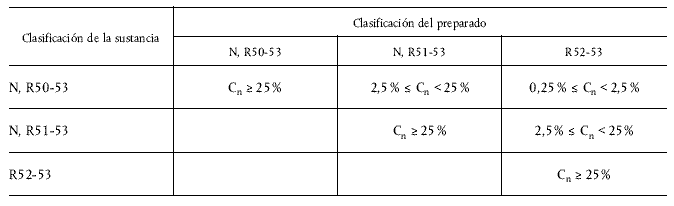
Table 2
Acute aquatic toxicity
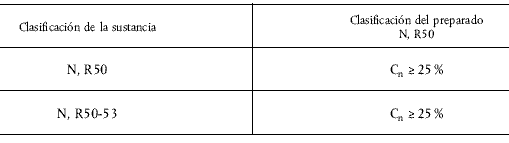
Table 3
Aquatic toxicity

Table 4
Long-term adverse effects
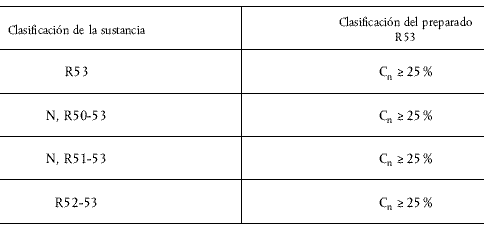
(...)
Acute aquatic toxicity and long-term harmful effects
Table 2
Acute aquatic toxicity
Table 3
Aquatic toxicity
Table 4
Long-term adverse effects
(...)
Test methods for the assessment of hazards to the aquatic environment
Classification of a preparation is usually done according to the conventional method. However, in some cases the preparation may be tested to determine its acute aquatic toxicity.
The results of these preparation tests can only change the classification for acute aquatic toxicity that would be obtained using the conventional method.
If the person responsible for placing the product on the market chooses these tests, they shall be carried out in accordance with the quality criteria of the methods set out in Part C Annex V to Directive 67/548/EEC.
In addition, the tests shall be carried out on each of the three species provided for in accordance with the criteria set out in Annex VI to Directive 67/548/EEC (algae, dafnia and fish), unless the highest hazard classification relating to acute aquatic toxicity has already been attributed to the preparation after the test in one of the species or the result of a test before the entry into force of this Directive is already available.
Links a Chemical safety sheets, lists and databases
Safety cards MTAS - Spanish
Limitations on the use and consumption of chemical agents MTAS - Spanish
Annex I to Royal Decree 363/1995 of 10 March 1995 regulating the notification of new substances and classification, packaging and labelling of dangerous substances and their subsequent amendments
Annex I to Directive 67/548/EEC (Regulation 1272/2008 - USG) EU: this is the official and updated database where you can find the letter N with danger phrases R50 / R50-53 / R51-53 for classification as class 9 for ADR 2011
Find: materials with N
Examples of goods with hazard phrases R50 / R50-53 / R51-53
R50 Very toxic to aquatic organisms.
007-001-01-2 AMONIACO ... %
015-025-00-2 TEPP (ISO)
015-028-00-9 DEMETON-O (ISO)
015-046-00-7 TIOFOSFATO DE O,O-DIMETILO Y DE S-(2-ETILSULFINIL-ETILO)
015-118-00-8 DEMETON
053-001-00-3 YODO
602-053-00-0 ISOBENZAN (ISO)
604-007-00-5 2-NAFTOL
604-020-00-6 BIFENIL-2-OL
607-066-00-5 ACIDO DICLOROACETICO
607-067-00-0 CLORURO DE DICLOROACETILO
607-070-00-7 CLOROACETATO DE ETILO
607-081-00-7 ACIDO FLUOROACETICO
607-082-00-2 FLUOROACETATOS SOLUBLES
607-169-00-5 FLUOROACETATO DE SODIO
616-009-00-3 PROPANIL (ISO)
R50/53 Very toxic to aquatic organisms, it can cause long-term adverse effects on the aquatic environment.
050-017-00-2 OXIDO DE FENBUTATINA (ISO)
006-006-00-X ACIDO CIANHIDRICO
006-007-00-5 SALES DEL ACIDO CIANHIDRICO, EXCEPTO LOS CIANUROS COMPLEJOS, TALES COMO LOS FERROCIANUROS Y FERRICIANUROS Y OXICIANURO DE MERCURIO
006-015-00-9 DIURON (ISO)
006-017-00-X ALDICARB (ISO)
006-019-00-0 DIALATO (ISO)
006-020-00-6 BARBAN (ISO)
006-021-00-1 LINURON (ISO)
006-031-00-6 FORMETANATO
006-038-00-4 SULFALATO (ISO)
006-039-00-X TRIALATO (ISO)
006-042-00-6 MONURON (ISO)
006-043-00-1 MONURON-TCA
006-044-00-7 ISOPROTURON
006-046-00-8 BENDIOCARB (ISO)
006-052-00-0 FORMETANATO,CLORHIDRATO
006-054-00-1 MEXACARBATO (ISO)
006-079-00-8 "DISULFIRAMO OXIGENO"
Zinc 006-081-009 bis(dibutyldithiocarbamate)
006-084-00-5 [(DIBUTILAMINO)TIO]METILCARBAMATO DE 2,3-DIHIDRO-2,2-DIMETIL-7-BENZOFURILO
007-021-00-4 HIDRAZOBENCENO
007-024-00-0 CLORATO DE 2-(DECILTIO)ETILAMONIO
011-004-00-7 AZIDURO DE SODIO
015-038-00-3 CUMAFOS (ISO)
015-056-00-1 AZINFOS-ETIL (ISO)
015-064-00-5 BROMOFOS-ETIL (ISO)
015-067-00-1 FOSALON
015-069-00-2 METIDATION (ISO)
015-071-00-3 CLORFENVINFOS (ISO)
015-073-00-4 DICROTOFOS (ISO)
015-088-00-6 DIALIFOS (ISO)
015-093-00-3 LEPTOFOS (ISO)
015-098-00-0 TRICLORONATO (ISO)
015-099-00-6 PIRIMIFOS-ETILO (ISO)
015-140-00-8 TRIAZOFOS (ISO)
015-141-00-3 DITIOFOSFATO DE ETILENDIAMONIO Y O,O-BIS(OCTILO), MEZCLA DE ISOMEROS
015-156-00-5 [1] 3-[(DIMETOXIFOSFINOTIOIL)OXI]METACRILATO DE METILO
015-156-00-5 [2] "METACRIFOS (ISO)"
016-021-00-3 METANOTIOL
016-022-00-9 ETANOTIOL
016-083-00-1 ACIBENZOLAR-S-METIL
020-002-00-5 CIANURO DE CALCIO
024-008-00-9 CROMATO DE CALCIO
024-009-00-4 CROMATO DE ESTRONCIO
024-017-00-8 COMPUESTOS DE CROMO (VI),EXCEPTO EL CROMATO DE BARIO Y DE LOS ESPECIALMENTE CITADOS EN ESTE ANEXO
025-002-00-9 PERMANGANATO DE POTASIO
027-002-00-4 ÓXIDO DE COBALTO
028-006-00-9 SULFURO DE NÍQUEL
029-003-00-5 ACIDOS NAFTENICOS, SALES DE COBRE
029-004-00-0 SULFATO DE COBRE
029-008-00-2 METANSULFONATO DE COBRE(II)
030-007-00-4 BIS(3,5-DI-terc-BUTILSALICILATO-O1,O2)CINC
033-004-00-6 PENTAOXIDO DE DIARSENICO
033-005-00-1 ACIDO ARSENICO Y SUS SALES
034-002-00-8 COMPUESTOS DE SELENIO, EXCEPTO EL SULFOSELENIURO DE CADMIO
042-003-00-X HEXA-MU-OXOTETRA-MU3-OXODI-MU5-OXOTETRADECAOXOOCTAMOLIBDATO(4-) DE TETRAKIS(TRIMETILHEXADECILAMONIO)
080-001-00-0 MERCURIO
080-002-00-6 COMPUESTOS INORGANICOS DE MERCURIO, EXCEPTO EL SULFURO MERCURICO (CINABRIO) Y LOS ESPECIFICAMENTE EXPRESADOS EN ESTE ANEXO
080-003-00-1 DICLORURO DE DIMERCURIO
080-004-00-7 COMPUESTOS ORGANICOS DE MERCURIO, EXCEPTO LOS ESPECIFICAMENTE EXPRESADOS EN ESTE ANEXO
080-007-00-3 [1] DIMETILMERCURIO
080-007-00-3 [2] DIETILMERCURIO
080-008-00-9 [1] NITRATO DE FENILMERCURIO
080-008-00-9 [2] HIDROXIDO DE FENILMERCURIO
080-008-00-9 [3] NITRATO DE FENILMERCURIO BASICO
080-009-00-4 CLORURO DE 2-METOXIETILMERCURIO
080-011-00-5 ACETATO DE FENILMERCURIO
601-048-00-0 CRISENO
601-053-00-8 [1] NONILFENOL
601-053-00-8 [2] 4-NONILFENOL, RAMIFICADO
602-034-00-7 1,2-DICLOROBENCENO
602-041-00-5 PENTACLORONAFTALENO
602-043-00-6 GAMMA-1,2,3,4,5,6-HEXACLOROCICLOHEXANO
602-045-00-7 DDT (NOMBRE COMÚN NO ADOPTADO POR ISO)
602-047-00-8 CLORDANO (ISO)
602-048-00-3 ALDRIN (ISO)
602-051-00-X ENDRIN (ISO)
602-052-00-5 ENDOSULFAN (ISO)
602-065-00-6 HEXACLOROBENCENO
602-071-00-9 BROMOBENCILBROMOTOLUENO, MEZCLA DE ISOMEROS
602-074-00-5 PENTACLOROBENCENO
602-083-00-4 DIFENIL ÉTER, DERIVADO PENTABROMADO
602-087-00-6 1,2,4-TRICLOROBENCENO
602-089-00-7 4-BROMO-2-CLOROFLUOROBENCENO
603-156-00-3 2-(2,4-DICLOROFENIL)-2-(2-PROPENIL)OXIRANO
604-013-00-8 2,3,4,6-TETRACLOROFENOL
604-017-00-X 2,4,5-TRICLOROFENOL
604-019-00-0 DICLOROFENO
604-024-00-8 4,4'-ISOBUTILETILIDENDIFENOL
604-041-00-0 [1] ACIDO 5-[2-CLORO-4-(TRIFLUOROMETIL)FENOXI]-2-NITROBENZOICO
604-041-00-0 [2] 5-[2-CLORO-4-(TRIFUOROMETIL)FENOXI]-2-NITROBENZOATO DE SODIO
604-053-00-6 2-METIL-4-(1,1-DIMETILETIL)-6-(1-METIL-PENTADECIL)-FENOL
604-062-00-5 2,4-DIMETIL-6-(1-METIL-PENTADECIL)-FENOL
606-014-00-9 CLOROFACINONA (ISO)
606-018-00-0 DICLONA (ISO)
606-019-00-6 CLORDECON (ISO)
606-044-00-2 2,4,6-TRIMETILBENZOFENONA
607-041-00-9 2,4,5-T
607-042-00-4 SALES Y ESTERES DEL 2,4,5-T
607-047-00-1 FENOPROP
607-076-00-X DODINA
607-151-00-7 PROPARGITA (ISO)
607-156-00-4 CLOROFENSON (ISO)
607-157-00-X 3-(3-BIFENIL-4-IL-1,2,3,4-TETRAHIDRO-1-NAFTIL)-4-HIDROXICUMARINA
607-165-00-3 2-(4-(2,4-DICLOROFENOXI)FENOXI)PROPIONATO DE METILO
607-168-00-X 6,7-METILENDIOXI-1,2,3,4-TETRAHIDRO-3-METILNAFTALENO-1,2-DICARBOXILATO DE DIPROPILO
607-172-00-1 4-HIDROXI-3-(3-(4'-BROMO-4-BIFENILIL)-1,2,3,4-TETRAHIDRO-1-NAFTIL)CUMARINA
607-191-00-5 3,4-EPOXIBUTIRATO DE ISOBUTILO
607-209-00-1 MEZCLA DE: O,O-DI(1-METILETIL)TRITIO-BIS-TIOFORMATO;O,O-DI(1-METILETIL)TETRATIO-BIS-TIOFORMATO;O,O-DI(1-METILETIL)PENTATIO-BIS-TIOFORMATO
607-232-00-7 PIRIDATO (ISO)
607-238-00-X TAU-FLUVALINATE
607-242-00-1 ANIHIDRIDO TETRACLOROFTALICO
607-253-00-1 3-(2,2-DICLOROVINIL)-2,2-DIMETILCICLOPROPANOCARBOXILATO DE alfa-CIANO-3-FENOXI-4-FLUOROBENCILO
607-290-00-3 MEZCLA (PROPORCIÓN DESCONOCIDA) DE: AMONIO 1-C14-C18-ALQUILOXICARBONIL-2-(3-ALILOXI-2-HIDROXIPROPOXICARBONIL)ETAN-1-SULFONATO;AMONIO 2-C14-C18-ALQUILOXICARBONIL-1-(3-ALILOXI-2-HIDROXIPROPOXICARBONIL)ETAN-1-SULFONATO
607-299-00-2 3-(ACETILTIO)-2-METIL-PROPANATO DE METILO
607-308-00-X ÉSTERES DE 2,4-D
607-328-00-9 4-BROMOMETIL-3-METOXIBENZOATO DE METILO
607-333-00-6 MEZCLA DE: N-(2,2,6,6-TETRAMETILPIPERIDIN-4-IL)-beta-ALANINATO DE DODECILO; N-(2,2,6,6-TETRAMETILPIPERIDIN-4-IL)-beta-ALANINATO DE TETRADECILO
607-375-00-5 MEZCLA DE: cis-4-HIDROXI-3-(1,2,3,4-TETRAHIDRO-3-(4-(4-TRIFLUOROMETILBENCILOXI)FENIL)-1-NAFTIL)CUMARINA; trans-4-HIDROXI-3-(1,2,3,4-TETRAHIDRO-3-(4-(4-TRIFLUOROMETILBENCILOXI)FENIL)-1-NAFTIL)CUMARINA
608-011-00-8 OXALONITRILO
608-017-00-0 OCTANOATO DE BROMOXINILO (ISO)
608-018-00-6 OCTANOATO DE IOXINILO (ISO)
609-004-00-2 [1] DINITROBENCENO
609-004-00-2 [2] 1,4-DINITROBENCENO
609-004-00-2 [3] 1,3-DINITROBENCENO
609-004-00-2 [4] 1,2-DINITROBENCENO
609-016-00-8 [1] DINITROFENOL
609-016-00-8 [2] 2,4 (o 2,6)-DINITROFENOL
609-021-00-5 [1] SAL DE SODIO DEL DNOC
609-021-00-5 [2] SAL DE POTASIO DEL DNOC
609-022-00-0 SAL DE AMONIO DEL DNOC
609-024-00-1 BINAPACRIL (ISO)
609-044-00-0 TECNACENO (ISO)
609-046-00-1 TRIFLURALINA (ISO) (CONTENIDO < 0.5 PPM NPDA)
610-003-00-4 CLORODINITROBENCENO
610-004-00-X 2-CLORO-1,3,5-TRINITROBENCENO
611-064-00-X 4-(3,4-DICLOROFENILAZO)-2,6-DI-sec-BUTIL-FENOL
611-089-00-6 METILSULFATO DE 2-((4-(ETIL-(2-HIDROXIETIL)AMINO)-2-METILFENIL)AZO)-6-METOXI-3-METIL-BENZOTIAZOLIO
612-010-00-8 CLOROANILINA (MONO-,DI-,TRI-)
612-015-00-5 N-METILANILINA
612-026-00-5 DIFENILAMINA
612-029-00-1 [1] m-FENILENODIAMINA,DICLORHIDRATO
612-042-00-2 BENCIDINA
612-064-00-2 3,6,9,12-TETRAAZATETRADECANO-1,14-DIAMINA
612-066-00-3 DICICLOHEXILAMINA
612-070-00-5 [1] SALES DE BENCIDINA [1]
612-070-00-5 [2] SALES DE BENCIDINA [2]
612-070-00-5 [3] SALES DE BENCIDINA [3]
612-070-00-5 [4] SALES DE BENCIDINA [4]
612-078-00-9 2,2'-DICLORO-4,4'-METILENDIANILINA
612-079-00-4 SALES DE 2,2'-DICLORO-4,4'-METILENDIANILINA
612-087-00-8 GUAZATINA
612-095-00-1 BENZOATO DE BENCIL-2-HIDROXIDODECILDIMETILAMONIO
612-113-00-8 6-METIL-2,4-BIS(METILTIO)FENILENO-1,3-DIAMINA
612-128-00-X 4-AMINOFENOL
612-130-00-0 [1] 2,6-DIAMINO-3,5-DIETILTOLUENO
612-130-00-0 [2] 2,4-DIAMINO-3,5-DIETILTOLUENO
612-130-00-0 [3] DIETILMETILBENCENODIAMINA
612-134-00-2 SESQUISULFATO DE N-(2-(4-AMINO-N-ETIL-M-TOLUIDINO)ETIL) METANOSULFONAMIDA
612-136-00-3 N'-FENIL-N-ISOPROPIL-p-FENILENDIAMINA
612-141-00-0 4,4'-METILENBIS(2-ETILANILINA)
612-144-00-7 FLUMETRALINA (ISO)
612-159-00-9 PRODUCTOS DE REACCIÓN DE: TRIMETILHEXAMETILENODIAMINA (MEZCLA DE 2,2,4 -TRIMETIL-1,6-HEXANODIAMINA Y 2,4,4-TRIMETIL-1,6-HEXANODIAMINA, CATALOGADA EN EINECS), EPOXIDO 8 (DERIVADOS DE MONO[(C10-C16-ALQUILOXI)METIL]OXIRANO) Y ÁCIDO p-TOLUENO-SULFÓNICO
612-170-00-9 4-CLOROFENILCICLOPROPILCETONA-O-(4-AMINO-BENCIL)OXIMA
613-008-00-X DAZOMET (ISO)
613-042-00-5 1-[2-(ALILOXI)-2-(2,4-DICLOROFENIL)ETIL]-1H-IMIDAZOL
613-043-00-0 [1] HIDROGENOSULFATO DE 1-[2-(ALILOXI)ETIL-2-(2,4-DICLOROFENIL)]-1H-IMIDAZOLIO
613-043-00-0 [2] HIDROGENOSULFATO DE (+ -)-1-[2-(ALILOXI)ETIL-2-(2,4-DICLOROFENIL)]-1H-IMIDAZOLIO]
613-046-00-7 CAPTAFOL (ISO)
613-047-00-2 DIMETILAN (ISO)
613-063-00-X SECBUMETON (ISO)
613-068-00-7 ATRAZINA (ISO)
613-080-00-2 3-(BIS(2-ETILHEXIL)AMINOMETIL)BENZOTIAZOL-2(3H)-TIONA
613-099-00-6 1-DODECIL-2-PIRROLIDONA
613-132-00-4 3-CICLOHEXIL-6-DIMETILAMINO-1-METIL-1,2,3,4-TETRAHIDRO-1,3,5-TRIAZINA-2,4-DIONA
613-135-00-0 DISULFURO DE DI(BENZOTIAZOL-2-ILO)
613-159-00-1 4-[2-[4-(1,1-DIMETILETIL)FENIL]-ETOXI]QUINAZOLINA
613-164-00-9 FLUFENACET (ISO)
615-025-00-8 DICIANATO DE 4,4'-ETILIDENDIFENILO
616-031-00-3 2-CLORO-N-(2,6-DIMETILFENIL)-N-(2-METOXIETIL)ACETAMIDA
616-033-00-4 N-(3-CLOROFENIL)-N-(TETRAHIDRO-2-OXO-3-FURIL)CICLOPROPANOCARBOXAMIDA
616-035-00-5 2-CIANO-N-[(ETILAMINO)CARBONIL]-2-(METOXIIMINO)ACETAMIDA
616-081-00-6 5-BROMO-8-NAFTOLACTAMA
617-015-00-9 BIS(4-METILBENZOIL)PERÓXIDO
650-005-00-2 (2R,6aS,12aS)-1,2,6,6a,12,12a-HEXAHIDRO-2-ISOPROPENIL-8,9-DIMETOXICROMENO[3,4-b]FURO[2,3-b]CROMEN-6-ONA
650-007-00-3 CLORDIMEFORM (ISO)
650-009-00-4 CLORODIMEFORM,CLORHIDRATO
650-031-00-4 SULFATO DE BIS(4-HIDROXI-N-METILANILINIO)
650-032-00-X CIPROCONAZOL (ISO)
650-033-00-5 ESFENVALERATO (ISO)
R51/53 Toxic to aquatic organisms, it can cause long-term adverse effects on the aquatic environment.
015-016-00-3 FOSFATO DE TRITOLILO
006-029-00-5 DIOXACARB (ISO)
006-034-00-2 PEBULATO (ISO)
006-056-00-2 METOLCARB (ISO)
006-057-00-8 NITRAPYRIN (ISO)
006-061-00-X N-(DIMETILAMINOPROPIL)TIOCARBAMATO DE S-ETILO CLORHIDRATO
006-066-00-7 DIPROPILTIOCARBAMATO DE S-PROPILO
006-072-00-X N,N-DIPROPILTIOCARBAMATO DE S-BENCILO
014-006-00-6 BIS(4-FLUOROFENIL)-METIL-(1,2,4-TRIAZOL-4-ILMETIL)SILANO, CLORHIDRATO
014-011-00-3 CICLOHEXILMETILDIMETOXISILANO
014-012-00-9 BIS(3-(TRIMETOXISILIL)PROPIL)AMINA
015-015-00-8 FOSFATOS DE TRITOLILO
015-031-00-5 DEMETON-S-METIL (ISO)
015-094-00-9 MEFOSFOLAN (ISO)
015-152-00-3 2-SULFURO DE 2-METOXI-4H-1,3,2-BENZODIOXAFOSFORINO
015-178-00-5 (-)-(1R, 2S)-(1,2-EPOXIPROPIL)FOSFONATO DE (R)-alfa-FENILETILAMONIO MONOHIDRATO
016-036-00-5 5'-(5-CIANO-4,6-DICLOROPIRIMIDIN-2-ILAMINO)-4'-HIDROXI-2,3'-AZODINAFTALENO-1,2',5,7'-DISULFONATO DE TETRASODIO
016-049-00-6 OCTADECILXILENSULFONATO DE CALCIO
016-052-00-2 4-HIDROXINAFTALENO-1-SULFONATO DE BENCILTRIBUTILAMONIO
016-068-00-X 3,5-BIS(TETRADECILOXICARBONIL)BENCENSULFINATO DE SODIO
016-069-00-5 ÁCIDO 3,5-BIS(TETRADECILOXICARBONIL)BENCENOSULFÍNICO
016-075-00-8 2,2'-DIALIL-4,4'-SULFONILDIFENOL
024-013-00-6 (6-ANILINO-2-(5-NITRO-2-OXIDOFENILAZO)-3-SULFONATO-1-NAFTOLATO)(4-SULFONATO-1,1'-AZODI-2,2'NAFTOLATO)CROMATO(1-) DE TRISODIO
025-003-00-4 SULFATO DE MANGANESO
029-006-00-1 (TRISULFONATOFTALOCIANINATO)COBRE(II) DE TRIS(OCTADEC-9-ENILAMONIO)
030-008-00-X HIDROXO(2-(BENCENSULFONAMIDO)BENZOATO)CINC(II)
051-001-00-8 TRICLORURO DE ANTIMONIO
051-002-00-3 PENTACLORURO DE ANTIMONIO
051-003-00-9 COMPUESTOS DE ANTIMONIO, EXCEPTO EL TETROXIDO (Sb2O4), EL PENTOXIDO (Sb2O5), EL TRISULFURO (Sb2S3), EL PENTASULFURO (Sb2S5) Y LOS ESPECIALMENTE EXPRESADOS EN ESTE ANEXO
051-004-00-4 TRIFLUORURO DE ANTIMONIO
601-005-00-6 2,2-DIMETILPROPANO
601-028-00-1 2-METILESTIRENO
601-031-00-8 2,4,4-TRIMETILPENT-1-ENO
601-047-00-5 M-MENTA-1,3(8)-DIENO
601-051-00-7 4-FENILBUT-1-ENO
602-015-00-3 1,1,2,2-TETRACLOROETANO
602-028-00-4 TETRACLOROETILENO
602-040-00-X [1] 2-CLOROTOLUENO [1]
602-040-00-X [2] 3-CLOROTOLUENO ([2]
602-040-00-X [3] 4-CLOROTOLUENO [3]
602-040-00-X [4] 4-CLOROTOLUENO [4]
602-056-00-7 ALFA,ALFA,ALFA-TRIFLUOROTOLUENO
602-082-00-9 2,2,6,6-TETRAKIS(BROMOMETIL)-4-OXAHEPTANO-1,7-DIOL
602-090-00-2 1-ALIL-3-CLORO-4-FLUOROBENCENO
603-049-00-1 CLORFENETOL (ISO)
603-092-00-6 4-FENIL-2-METILPENTANOL
603-093-00-1 EXO-(+/-)-1-METIL-4-(1-METILETIL)-2-[(2-METILFENIL)METOXI]-7-OXABICICLO[2.2.1]HEPTANO
603-135-00-9 BIS[[2,2',2''-NITRILOTRIS(ETANOLATO)]-1-N,O]BIS[2-(2-METOXIETOXI)ETOXI]-TITANIO
603-145-00-3 2-ISOPROPIL-2-(1-METILBUTIL)-1,3-DIMETOXIPROPANO
603-148-00-X 1,4-BIS[(VINILOXI)METIL]CICLOHEXANO
603-149-00-5 MEZCLA DE DIASTEREOISÓMEROS DE 1-(1-HIDROXIETIL)-4-(1-METILETIL)CICLOHEXANO
603-158-00-4 MEZCLA DE 4 DIASTEREOISÓMEROS DE 2,7-DIMETIL-10-(1-METILETIL)-1-OXASPIRO[4.5]DECA-3,6-DIENO
604-008-00-0 [1] 2-CLOROFENOL
604-008-00-0 [2] 4-CLOROFENOL
604-036-00-3 4,4'-OXIBIS(ETILENTIO)DIFENOL
605-027-00-7 MEZCLA DE: 3a,4,5,6,7,7a-HEXAHIDRO-4,7-METANO-1H-INDENO-6-CARBOXALDEHIDO;3a,4,5,6,7,7a-HEXAHIDRO-4,7-METANO-1H-INDENO-5-CARBOXALDEHIDO
605-029-00-8 2-CICLOHEXILPROPANAL
606-022-00-2 1-FENIL-3-PIRAZOLIDONA
606-032-00-7 HEXACLOROACETONA
606-037-00-4 TRIADIMEFON (ISO)
606-040-00-0 (N-BENCIL-N-ETIL)AMINO-3'-HIDROXIACETOFENONA, CLORHIDRATO
606-041-00-6 2-METIL-1-(4-METILTIOFENIL)-2-MORFOLINOPROPAN-1-ONA
606-043-00-7 2,4-DI-terc-BUTILCICLOHEXANONA
606-055-00-2 1-(2,3-DIHIDRO-1,3,3,6-TETRAMETIL-1-(1-METILETIL)-1H-INDEN-5-IL)-ETANONA
607-074-00-9 CLORFENAC
607-077-00-5 ERBON
607-083-00-8 2,4-DB (ISO)
607-116-00-6 ACRILATO DE CICLOHEXILO
607-133-00-9 MONOALQUIL O MONOARIL O MONOALQUILARIL ESTERES DE ACIDO ACRILICO EXCEPTO LOS ESPECIALMENTE CITADOS EN ESTE ANEXO
607-152-00-2 2,3,6-TBA (ISO)
607-174-00-2 3-(2,2,4,4-TETRAMETIL-21-OXO-7-OXA-3,20-DIAZADIESPIRO(5,1,11,2)HENICOSAN-20-IL)PROPIONATO DE DODECILO Y 3-(2,2,4,4-TETRAMETIL-21-OXO-7-OXA-3,20-DIAZADESPIRO(5,1,11,2)HENICOSAN-20-IL)PROPIONATO DE TETRADECILO, MEZCLA DE
607-175-00-8 2-(2-NITROBENCILIDEN)ACETOACETATO DE METILO
607-176-00-3 MEZCLA DE: alfa-3-(3-(2H-BENZOTRIAZOL-2-IL)-5-TERC-BUTIL-4-HIDROXIFENIL)PROPIONIL-omega-HIDROXIPOLI(OXIETILENO);alfa-3-(3-(2H-BENZOTRIAZOL-2-IL)-5-TERC-BUTIL-4-HIDROXIFENIL)PROPIONIL-omega-3-(3-(2H-BENZOTRIAZOL-2-IL)-5-TERC-BUTIL-4-HIDROXIFENIL)...
607-178-00-4 ALFA-((4,6-DIMETOXIPIRIMIDIN-2-IL)UREIDOSULFONIL)-O-TOLUATO DE METILO
607-183-00-1 2-HIDROXI-5-C13-18-ALQUILBENZOATO DE CINC
607-188-00-9 N-CARBOXILATOETIL-N-OCTADEC-9-ENILMALEAMATO DE HIDROGENO Y SODIO
607-211-00-2 3-(3-terc-BUTIL-4-HIDROXI-5-METULFENIL)PROPIONATO DE METILO
607-222-00-2 METACRILATO DE 6-(2,3-DIMETILMALEIMIDO)HEXILO
607-231-00-1 ÁCIDO 3,6-DICLOROPIRIDINA-2-CARBOXILICO
607-263-00-6 1,3-PROPANODIAMINA-N,N,N',N'-TETRAACETATO DE POTASIO Y HIERRO(III),HEMIHIDRATO
607-271-00-X 2-ISOPROPIL-5-METILCICLOHEXILOXICARBONILOXI-2-HIDROXIPROPANO
607-274-00-6 3-AMINO-2-BUTENOATO DE 2-(N-BENCIL-N-METILAMINO)ETILO
607-279-00-3 MEZCLA DE: BIS (HIDROGENOMALEATO) DE n-OCTADECILAMINODIETILO;HIDROGENOMALEATO-HIDROGENOFTALATO DE n-OCTADECILAMINODIETILO
607-295-00-0 MEZCLA DE: FOSFONOETAN-1,2-DICARBOXILATO DE TETRASODIO; FOSFONOBUTAN-1,2,3,4-TETRACARBOXILATO DE HEXASODIO
607-306-00-9 CLOZOLINATO (ISO)
607-315-00-8 GLIFOSATO (ISO)
607-316-00-3 GLIFOSATO-TRIMESIO
607-322-00-6 ÁCIDO 4-(4,4-DIMETIL-3-OXO-PIRAZOLIDIN-1-IL)-BENZOICO
607-326-00-8 MEZCLA DE: 2-(alfa-2,4,6-TRIMETILNON-2-ENIL)SUCCINATO DE ISOBUTILO E HIDROGENO; 2-(beta-2,4,6-TRIMETILNON-2-ENIL) SUCCINATO DE ISOBUTILO E HIDROGENO
607-327-00-3 DIACETATO DE 2-(2-IODOETIL)-1,3-PROPANODIOL
607-342-00-5 VERATRATO DE 4-CLOROBUTILO
607-353-00-5 MEZCLA DE: exo-TRICICLO[5.2.1.0^2,6]DECANO-endo-2-CARBOXILATO DE ETILO; endo-TRICICLO[5.2.1.0^2,6]DECANO-exo-2-CARBOXILATO DE ETILO
607-356-00-1 trans-2,2,6-TRIMETILCICLOHEXANOCARBOXILATO DE ETILO
607-362-00-4 MEZCLA DE: 2-(2-(BIS(2-HIDROXIETIL)AMINO)ETOXICARBONILMETIL)HEXADEC-4-ENOATO DE (3-METOXI)PROPILAMONIO/[TRIS-(2-HIDROXIETL)]-AMONIO; 2-(2-(BIS(2-HIDROXIETIL)AMINO)ETOXICARBONILMETIL)HEXADEC-4-ENOATO DE (3-ETOXI)PROPILAMONIO/[TRIS-(2-HIDROXIETIL)]-AMONIO..
607-374-00-X DICLORURO DE 5-AMINO-2,4,6-TRIIODO-1,3-BENCENODICARBONILO
608-002-00-9 TRICLOROACETONITRILO
608-008-00-1 CLOROACETONITRILO
608-015-00-X DICLOBENIL (ISO)
609-038-00-8 2-NITRONAFTALENO
609-039-00-3 4-NITROBIFENILO
609-063-00-4 2-[(4-CLORO-2-NITROFENIL)AMINO]ETANOL
610-008-00-1 2,6-DICLORO-4-NITROANISOL
610-009-00-7 2-CLORO-4-NITROANILINA
611-011-00-0 DILACTATO DE N,N,N',N'-TETRAMETIL-3,3'-(PROPILENBIS(IMINOCARBONIL-4,1-FENILENAZO(1,6-DIHIDRO-2-HIDROXI-4-METIL-6-OXOPIRIDINA-3,1-DIIL)))DI(PROPILAMONIO)
611-013-00-1 1-HIDROXI-7-(3-SULFONATOANILINO)-2-(3-METIL-4-(2-METOXI-4-(3-SULFONATOFENILAZO)FENILAZO)FENILAZO)NAFTALENO-3-SULFONATO DE TRILITIO
611-017-00-3 2-(4-(DIETILAMINOPROPILCARBAMOIL)FENILAZO)-3-OXO-N-(2,3-DIHIDRO-2-OXOBENCIMIDAZOL-5-IL)BUTIRAMIDA
611-035-00-1 6-AMINO-4-HIDROXI-3-[7-SULFONATO-4-(5-SULFONATO-2-NAFTILAZO)-1-NAFTILAZO]NAFTALENO-2,7-DISULFONATO DE TETRALITIO
611-075-00-X MEZCLA (2:1) DE: 4-AMINO-3-(4-(4-(2-AMINO-4-HIDROXIFENILAZO)ANILINO)-3-SULFONATOFENILAZO)-5,6-DIHIDRO-5-OXO-6-FENILHIDRAZONONAFTALENO-2,7-DISULFONATO DE TRIS(3,5,5-TRIMETILHEXILAMONIO); 4-AMINO-3-(4-(4-(4-AMINO-2-HIDROXIFENILAZO)ANILINO-3-SULFONATOFEN...
611-078-00-6 ACETATO Y LACTATO DE (2,2'-(3,3'-DIOXIDOBIFENIL-4,4'-DIILDIAZO)BIS(6-(4-(3-(DIETILAMINO)PROPILAMINO)-6-(3-(DIETILAMONIO)PROPILAMINO)-1,3,5-TRIAZIN-2-ILAMINO)-3-SULFONATO-1-NAFTOLATO))DICOBRE(II)
611-085-00-4 MEZCLA DE: 3-CIANO-5-(2-CIANO-4-NITRO-FENILAZO)-2-(2-HIDROXI-ETILAMINO)-4-METIL-6-[3-(2-FENOXIETOXI)PROPILAMINO]PIRIDINA; 3-CIANO-5-(2-CIANO-4-NITRO-FENILAZO)-6-(2-HIDROXI-ETILAMINO)-4-METIL-2-[3-(2-FENOXIETOXI)PROPILAMINO]PIRIDINA; 3-CIANO-5-(2-CIANO..
611-097-00-X MEZCLA DE ISÓMEROS DE COMPLEJOS DE HIERRO (1:2) Y DE UNA MEZCLA DE ISÓMEROS DE: 1,3-DIHIDROXI-4-[(5-FENILAMINOSULFONIL)-2-HIDROXI-FENILAZO]-n-(5-AMINO-SULFONIL-2-HIDROXI-FENILAZO)BENCENO (n=2,5,6); ISÓMEROS DE: 1,3-DIHIDROXI-4-[(5-FENILAMINOSULFONIL)-2...
612-020-00-2 1-NAFTILAMINA
612-127-00-4 3-AMINOFENOL
612-168-00-8 3,5-DICLORO-2,6-DIFLUOROPIRIDIN-4-AMINA
612-181-00-9 2-FENILTIOANILINA
613-057-00-7 DODEMORF (ISO)
613-078-00-1 N,N',N'',N'''-TETRAKIS(4,6-BIS(BUTIL-(N-METIL-2,2,6,6-TETRAMETILPIPERIDIN-4-IL)AMINO)TRIAZIN-2-IL)-4,7-DIAZADECAN-1,10-DIAMINA
613-098-00-0 N-(n-OCTIL)-2-PIRROLIDINONA
613-110-00-4 PIPERIDINA-1-CARBOTINATO DE 5-(1-FENIL-1-METILETILO)
613-122-00-X DICLOBUTRAZOLE
613-130-00-3 HEXACONAZOL (ISO)
613-142-00-9 ACETATO DE TRANS-N-METIL-2-ESTIRIL-[4'-AMINOMETINO-(1-ACETIL-1-(2-METOXIFENIL)ACETAMIDO)]PIRIDINIO
613-146-00-0 IODURO DE N-ETIL-N-METILPIPERIDINIO
613-152-00-3 N-(4,6-DIMETOXIPIRIMIDIN-2-IL)CARBAMATO DE FENILO
613-156-00-5 2-BUTIL-4-CLORO-5-FORMILIMIDAZOL
614-002-00-X SALES DE NICOTINA
616-048-00-6 3'-TRIFLUOROMETILISOBUTIRANILIDA
649-007-00-6 ACIDOS GRASOS, ACEITE DE RESINA, PRODUCTOS DE REACCION CON IMINODIETANOL Y ACIDO BORICO