Book Index 1. Security. Environment. [empty-origin file]
2. Road transport contract. Transport ADR.
3. Transfer of hazardous wastes. Authorizations to the Manager.
ANNEXES I - VI. Annexes VII - IX. References. Courses in 2008
F.F. finalist. Corell Other publications F. Corell Order - 12 €
Transport of waste
Dangerous by road
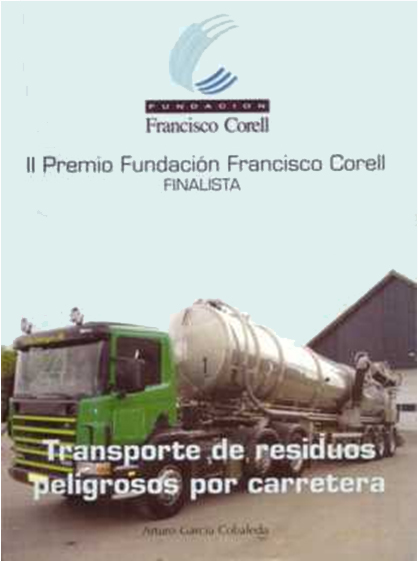
Transport of hazardous waste by road
Arturo García Cobaleda.
Environmental lawyer.
Fundación Francisco Corell
November 2003
To purchase the book click on the image:
0. Preamble.
The aim of the Francisco Corell Foundation award, under which this work is published, is to encourage research in the field of safety and environment related to road transport.
This monograph focuses on the technical-legal study of the transport of hazardous waste: road shipment is the most common way within national transport of hazardous waste, as it is the most adaptable way to the needs of producers.
Its transport regulations are regularly adapted to international ADR regulations on dangerous goods, and environmental regulations are renewed in parallel with successive amendments to the Basel Convention, which reflect national rules.
The study of the updated legislation applicable to the sector, is necessary for the maintenance of an effective management of the services and functions of the carrier, affected in addition to its own regulation, by the environment, and certain aspects of safety at work and quality management of its services.
Integrated business management is an indispensable element of competitiveness, and the guarantee for the validation of the service, by the external audit, which will give credibility to the carrier of hazardous waste vis-à-vis its customers and society.
French Corell Foundation.
Contents index.
0. Preamble. Contents index. Approach.
1. Security. Environment. [empty-origin file]
(a) Consequence of rules. Common European Union policy. Autonomous Standards. Local regime and urban waste. Integrated pollution control. Transport of Dangerous Goods. Royal Decree 2.115/1998 (replaced by Royal Decree 97/2014) and Law 10/1998. National hazardous waste plan.
(b) Social alarm. Main causes of accident. Prevention. Security. Risk control and implementation of integrated management systems. Reuse and recycling policy: minimization of risks and management costs.
(c) Appropriations and security measures. Vocational training of the driver. Instructions to the authorised driver. Security adviser. Approval of vehicles. Standards of standardization. Periodic review: ITV-ECA. Inspection.
(d) Voluntary CERET agreements between the chemical industry (FEIQUE) and Dir. General of Civil Protection for accident cases in transport of Dangerous Goods. Civil protection files for action in case of accidents in transport of dangerous goods. Risks at chemically-risk workplaces.
2. Road transport contract. Transport ADR.
(a) Transport. General of the contract of carriage. Transport activity. Road transport contract. Subjects involved. Professional training of freight forwarder.
(b) Application of the International ADR Convention to the domestic sphere. Exemptions. Signaling and labelling. Documents to be carried on board. Letter of carriage. List of checks for loading dangerous goods.
(c) Classification of dangerous goods. Nature of dangerous materials and objects transported. Personal protective equipment. Packing. Solutions and mixtures. Separation of materials. Prohibition of mixing waste.
(d) Characterization of waste hazardous to the environment. Multilateral Agreement M-80. Vehicles with ADR and RD 2.115/98 certificates. Vacuum-operated cisterns for the transport of hazardous waste.
3. Transfer of hazardous wastes. Authorizations to the Manager.
(a) International conventions. Implementation of Community waste legislation. Internal shipment of hazardous waste. Classification of hazardous waste. Control and follow-up document. Index of hazardous waste (MAM 304 2002). Precautionary principle in the authorisation of new substances.
(b) Insurance and bail. Application for management authorisation. Documentary record. Annual activity report.
ANNEXES I - VI.
I. International Conventions on Waste Transfer and Pollution.
II. Regional conventions on waste transfer and pollution.
III. Community legislation.
IV. State regulations.
V. Regional regulations.
VI. Bibliography consulted.
Annexes VII - IX.
VII. Glossary.
VIII. List of acronyms used.
IX. Units of measurement.
References.
The author
Approach.
This book contains the presentation of the legal regime for the transport of hazardous waste by road, within the scope of external management of hazardous waste (collection, transport and treatment).
These include aspects such as safety and the environment, from the point of view of transport and the management of shipments of hazardous waste.
It is appropriate to distinguish the transport of hazardous wastes when they are in the name of the carrier and when they do not have the transfer of title. Where hazardous waste is transported in the name of the carrier, the carrier has the status of authorised waste manager, with a procedure regulated by the Environment Departments of each Autonomous Community.
Transport without the transfer of title to the goods – in this case hazardous waste – is nothing more than a contract of carriage governed by administrative rules for the transport of dangerous goods, without affecting environmental regulation on waste. The only obligation to the Environmental Administration would be prior notification of the shipment. [1]
The procedure for the management of industrial waste - hazardous - begins with the issuance of the document accepting the waste by the authorised manager, which involves the transfer of responsibility and ownership over it, provided for in the current waste regulations. [2] From that moment on, the Managing Company becomes responsible for the waste until its arrival at the facilities of the final recovery/disposal managers, up to the intermediate transfer plants or temporary storage facilities.
The manager, in taking responsibility for such waste, has to deposit bonds and guarantees[3] to the Administration, in order to obtain their license, and thus to respond to any incidents that may arise on the way, and contracts insurance of civil liability for the shipments, which are not required to make mere intermediaries of the waste, without transmission of title. This ensures rapid intervention by the administration in the event of an accident with discharge or drop of the load.
Producer companies in need of managing their hazardous waste have the alternative of integrated external management, which consists of a system whereby “the Company delegates a service that needs systematic actions and can therefore better optimize its resources” (. . . ) “On the other hand, the external company can provide solutions based on experiences in other organizations.”[4] “The outsourcing of the Department of Environment “is a very cost-effective service for those companies that want to go toward green adaptation and do not know how to do it. ”[5]
TrafficADR (2001-2022) ISBN: 84-688-7476-0 2004.- © Home info@dgsa.es Privacy Policy and Legal Notice